The Accommodation Trap: When Protecting an Anxious Kid Keeps the Fear Going
Nearly every parent of an anxious child reshapes family life around the fear. Here is what the research says about why that can keep anxiety going, why the child's fear may drive it more than the parent does, and what a parent can change without getting harsh.
Lately, when I correct one of my daughters, she shrinks. She slinks back, avoids my eyes, and tries to disappear from the situation. It happens with both of them. I recognized it right away: they were bracing for me to be angry, for the yelling they expected to come next.
So I started pointing out how calm I am. I keep my voice level and ask, "Does it sound like I'm angry?" Often they say yes, even though I'm not. Other times they stop and think about it for a moment. Then I tell them plainly: "I'm not mad at you. But this behavior is not okay."
Why I Started Looking at the Research
If you have searched something like "my child is anxious, how do I help," you have probably found two kinds of answer. One tells you to be gentle, validate every feeling, and never push. The other tells you anxiety is a habit you are feeding, and the fix is to stop coddling. Both come with a lot of certainty and very few citations.
The research sits somewhere more interesting than either of them. It has a name for the ordinary, loving things parents do to take the edge off a child's fear: answering the reassurance question for the tenth time, ordering at the restaurant because they cannot bear to, driving them to school because the bus is too much, staying in the room until they fall asleep. Clinicians call it family accommodation. Nearly every parent of an anxious child does it. And a steady body of work, most of it from the last fifteen years, suggests that it is tangled up in why childhood anxiety sticks around.
I wrote before about how anxiety can come out looking like defiance, and how a kid who seems to be refusing is often a kid who is scared. This is the other side of that coin. Once you can see the fear, the natural move is to protect your kid from it. This post is about what the evidence says happens when you do, why it is so hard not to, and what a parent can do instead that does not involve becoming harsh.
I want to be clear about two things up front, because this topic gets used as a stick to hit parents with. First, accommodation is not a parenting failure. It is what caring adults do when a child they love is in distress, and the research on it was mostly done with parents who were trying hard. Second, the popular version gets the direction wrong. The link is real, but it is a loop, and in a study that tracked it session by session, the child's fear predicted later accommodation more strongly than accommodation predicted later fear.
What Accommodation Actually Is
The researcher most associated with this work, Eli Lebowitz at Yale, built a questionnaire called the Family Accommodation Scale-Anxiety, adapted from an earlier scale for OCD. It sorts accommodation into two broad kinds.[1]
Participation is when the parent takes part in the anxiety itself. Giving reassurance on request. Answering the same worried question over and over. Doing things for the child that the fear makes hard, like speaking to adults on their behalf. Sleeping beside them because they are frightened alone.
Modification is when the family's routines bend around the fear. Leaving events early. Not going places at all. Changing the drive to school to avoid a particular road. Rearranging the evening so the child never has to be in a room alone. Keeping a sibling home so the anxious child is not left without company.
When Lebowitz and colleagues first gave that questionnaire to 75 parents of anxious children at two anxiety specialty clinics and a general outpatient clinic, 97.3% reported at least some accommodation, and 76% reported both kinds.[1] Among the parents of children anxious enough to be seen at a clinic, accommodating was close to universal.
Two more numbers from that same study matter more than the headline one. 70.7% of parents said the accommodating itself caused them distress. And 85.3% said there were negative consequences when they did not accommodate: most often that the child's anxiety and distress got worse, and 56% said the child became angry or abusive.[1]
That second figure is the whole trap in one line. Parents are not accommodating because they think fear should be avoided on principle. They are accommodating because the alternative, in the moment, is a child in visible pain or a meltdown aimed at them. Anyone would.
Why Helping Can Keep the Fear Going
The reason accommodation matters comes from how anxiety is learned and unlearned.
Fear is a prediction. A child's nervous system has learned, correctly or not, that some situation is dangerous: the dark, being away from a parent, a room full of kids, being sick, being wrong. The body responds as if the prediction is true. Heart rate climbs, the stomach turns, the urge to escape takes over.
The way that prediction changes is by being tested and turning out to be wrong. Current models of exposure therapy describe this as inhibitory learning: the old fear memory does not get erased, but a new memory forms alongside it that says "I was in that situation and the bad thing did not happen," or "the bad thing happened and I coped."[2] The more that new learning gets reinforced, the more it wins out over the old prediction.
Here is where the parent comes in. Every time a situation gets avoided, the test never runs. The child never learns that the sleepover was survivable, that the teacher did not yell, that they could order their own food. And the relief that follows avoidance is real and fast, which teaches the nervous system something else: that escaping was what kept them safe.
The research on exposure also describes something called safety signals: things that make a feared situation bearable in the moment but get in the way of the new learning, so the fear comes back once they are gone. One of the optimisation strategies Michelle Craske and colleagues lay out for clinicians is removing them, and they list "the presence of another person" among the common ones.[2] I think it is a short step from there to see how a parent can become one for a child. If the only way a child has ever faced the dentist is with a parent holding their hand and talking them through every second, the lesson they learn may be "I can do this with Mom or Dad there," not "I can do this."
None of that means the hand-holding was wrong. It means that if it is the only way the child ever meets the fear, the fear does not get a chance to shrink.
The Myth, and What the Evidence Shows
The popular version of this idea goes something like: anxious kids are made by overprotective parents, so stop protecting them. That is not what the research shows, and what it does show changes what a parent should actually do.
The link is real
In 2021, a meta-analysis pulled together the studies measuring both family accommodation and child anxiety severity. More accommodation went with more severe anxiety: a moderate link when parents rated both, and a small one when children rated them or when the two ratings came from different people.[3]
It is a loop, and in one study the child's fear pulled harder
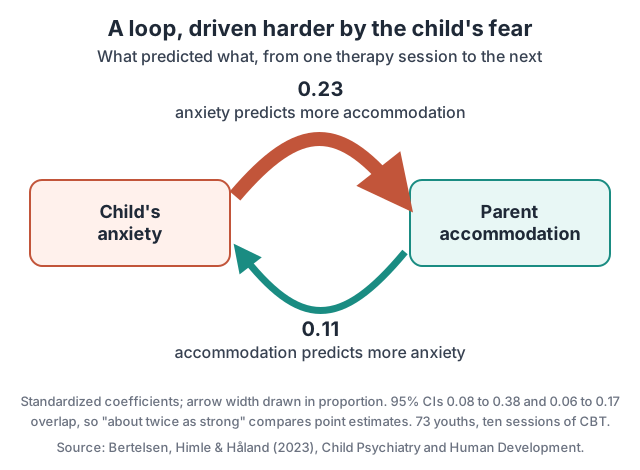
The most useful study I found for a parent reading this came out in 2023. Researchers in Norway measured accommodation and anxiety at each of ten sessions in 73 young people receiving group cognitive behavioural therapy (CBT) for anxiety, a program that itself worked with parents on reducing accommodation, and looked at which predicted which from one session to the next.[4]
Both did. Accommodation at one session predicted slightly higher anxiety at the next. But the stronger effect went the other way: a child's anxiety at one session predicted more accommodation at the next, roughly twice as strongly. The standardised coefficients were 0.11 in the first direction and 0.23 in the second, and the authors put the probability that the second is genuinely the larger at 91%.
In plain terms: anxious kids pull accommodation out of their parents, and accommodation in turn feeds a little more anxiety. It is a loop, and in this study the child's fear was the bigger engine of it, which points away from the "parents create anxious kids" story.
What part of parenting matters
A 2007 meta-analysis of 47 studies on parenting and childhood anxiety broke parenting into parts, and one stood out. Autonomy-granting, the degree to which a parent lets a child do things for themselves and make age-appropriate decisions, accounted for 18% of the variance in child anxiety on its own. Warmth accounted for less than 1%.[5]
So loving your kid more is not the lever. How much room they are given to face things themselves does seem to matter. The way I read it, accommodation is more or less the day-to-day measure of how much of that room the fear has taken away.
Why parents keep doing it
One more piece helps explain why this is hard to change by willpower. A 2018 study developed a measure of what parents believe about accommodation. Stronger positive beliefs predicted more accommodation even after accounting for how anxious the child was. The belief that did the most work was that accommodating prevents the child from losing behavioural and emotional control.[6]
That lines up with the 85% in the 2013 questionnaire study. Parents are not being soft. They are holding back a meltdown they have seen before.
There is also a link with parents' own anxiety. A cross-sectional study of 85 mothers found that accommodation statistically mediated the association between maternal anxiety and child anxiety.[7] I think it fits something many anxious parents will recognise: a child's distress is especially hard to sit through when you are anxious yourself. If that is you, it is not a character flaw. It is a second reason this is hard, and one worth naming.
The Boring Fundamentals: What Actually Helps
Here is the part nobody can sell you, because it is mostly free and mostly hard.
Treatment works, and many anxious kids go without it
Childhood anxiety is common. In a nationally representative US survey of children aged 3 to 17, parents reported that 7.1% had a diagnosed anxiety problem that was current, and only 59.3% of those children had received treatment or counseling from a mental health professional in the previous year.[8] That is a lot of kids and a lot of families managing without specialist help.
The treatments are good. In one of the largest trials of childhood anxiety treatment, the Child/Adolescent Anxiety Multimodal Study, 488 children aged 7 to 17 were randomised to CBT, the medication sertraline, both, or a placebo pill. After 12 weeks, 59.7% on CBT alone were rated much or very much improved, 54.9% on sertraline alone, 80.7% on the combination, and 23.7% on placebo.[9] CBT for anxiety is built around gradual, planned exposure to the things the child fears.
Parents can be the treatment
How parents are involved matters. An individual-patient meta-analysis of CBT trials for anxious children found that where parent involvement focused on transferring control to the child and rewarding brave behaviour, the share of children with an anxiety diagnosis kept falling over the following year, while gains in the other approaches held steady.[10]
Some programs go further and treat the child's anxiety by working only with the parent.
In a UK trial, 194 anxious children aged 7 to 12 were randomised to one of two versions of guided parent-delivered CBT, where parents learned the CBT techniques and used them at home with support from a therapist, or to a wait-list. With the fuller version, four face-to-face sessions and four phone sessions for the parent, 50% of children had recovered from their main anxiety diagnosis afterwards, against 25% on the wait-list.[11]
SPACE: treating the child by changing the parent's side of the loop
The program built directly around accommodation is called SPACE, for Supportive Parenting for Anxious Childhood Emotions. It was developed by Lebowitz, and it has an unusual feature: the child usually does not need to attend. Parents meet with a therapist, and the work is entirely about the parent's own behaviour.[12]
It has two moving parts. The first is shifting how the parent responds to the child's anxiety toward what the program calls supportive statements, which in the trial's description acknowledge the child's experience while also conveying confidence in the child's ability to cope.[13] The second is a planned, gradual reduction in specific accommodations, chosen and announced in advance, with the parent tracking it between sessions.[13]
In the first randomised trial, 124 children aged 7 to 14 with anxiety disorders were assigned either to SPACE, twelve weekly sessions for the parent with no therapist contact for the child, or to twelve sessions of standard CBT with the child and almost no parent involvement. SPACE was noninferior to CBT on the primary outcomes, rated by independent evaluators, and on the secondary anxiety ratings from parents and children. Response rates were 87.5% for SPACE and 75.5% for CBT, a difference that was not statistically significant. Accommodation dropped in both groups, and dropped more in the SPACE group.[13]
A second trial, with 68 children and teenagers with anxiety or OCD, compared standard SPACE delivered by video call against a lighter version: a book plus four sessions. Response rates were close, 70% for the standard version and 68% for the light one, with no significant difference on the main outcomes. Across both groups, the more parents reduced accommodation, the lower the child's anxiety tended to be afterwards.[14]
That is encouraging for a parent who cannot access a specialist. I read it as a sign that the core idea may carry much of the weight, not the number of sessions.
A 2026 systematic review of the twelve SPACE studies so far found that most reported reductions in both children's symptoms and family accommodation, and that SPACE was generally comparable to the other treatments it was tested against.[15]
When the Standard Advice Doesn't Fit
Kids whose anxiety comes out as anger
If your child's fear tends to come out as irritability or rage, parents in your position tend to report accommodating more, and for an understandable reason. A 2023 study of 128 anxious children and teenagers in CBT found that, going by parents' ratings, those more irritable before treatment had more parental accommodation and higher anxiety after it, and accommodation measured at the same time statistically accounted for part of that link.[16] The authors point toward helping these families reduce accommodation specifically when irritability is part of the picture. Nothing in the finding says the parents are doing something wrong. The cost of not accommodating is simply higher in their house. That fits the 56% of parents in the 2013 questionnaire study who said their child became angry or abusive when they did not accommodate.[1] If your house is one of those, reducing accommodation is harder and you deserve support doing it, not a lecture.
Autistic kids
Anxiety is common in autistic children: a meta-analysis of 31 studies found that about 40% of autistic young people had at least one anxiety disorder.[17] A 2026 systematic review of seventeen studies concluded that accommodation is present in families of anxious autistic children to at least the same degree as in families of anxious non-autistic children, if not more.[18] In a trial of 167 autistic young people with anxiety, higher accommodation before treatment predicted higher anxiety afterwards, and accommodation fell over treatment, staying higher in children who did not respond.[19] In a community study of 132 families, the child's difficulty with uncertainty predicted all four areas the accommodation questionnaire measures: taking part in the anxiety, changing routines, the parent's own distress, and what happens when the parent does not accommodate.[20]
There is an important distinction here that the research term blurs. "Accommodation" in this literature means changes made to help a child avoid or escape anxiety. It does not mean the supports an autistic child may need: sensory adjustments, predictable routines, advance warning of changes, communication supports. Nothing in this post argues against those. The line between the two is not always clean. A reasonable test, I think, is whether a support helps your child do more of their life, or whether it is steadily shrinking the list of things they can do.
A small pilot of SPACE, in which 22 families of autistic children aged 6 to 10 enrolled and 15 completed 13 weekly sessions, found it was feasible and that anxiety and accommodation both dropped, with the improvement holding two months later.[21]
Two households
If accommodation happens in one house and not the other, it is easy to decide that the other house is doing it wrong in one direction or the other. I would resist that. I wrote about what predicts how kids do after a separation, and the thing that consistently hurts them is being pulled into the conflict between their parents. A disagreement about how to handle a child's anxiety is exactly the kind of thing that can turn into that conflict, with the child in the middle of it.
What SPACE teaches is, by design, something one parent can do alone. The program works on the parent's own behaviour and does not require the child's cooperation. By the same logic, I think it does not require the other household's cooperation either. Your house can be a place where the child is met with support and confidence and where the fear is not running the schedule, whatever happens elsewhere. If you and your co-parent can agree on an approach, that is a bonus. It is not a precondition.
My daughters are angry about the divorce, for more than one reason. One of them is a fear that I will be taken away from them someday, and that fear is not unfounded. I had to step back and look at how I was answering it. The best I can do is encourage their relationship with their mom, and reassure them that their dad is not going anywhere. Every day we are together, I promise them their dad is here to stay and nothing will take me away from them. It has become part of our routine, so they know their dad will always be here for them.
What To Do Instead
The research does not support abruptly withdrawing everything, and it does not support forcing a child into the thing they fear. What the trials test is something slower and more deliberate. These steps are drawn from how the SPACE trials describe the work, combined with the exposure research above. They are not a substitute for a clinician, and if your child's anxiety is severe, the "When to Get Help" section below matters more than this one.
- Write down what you are actually doing. For a week, just notice. Every time you change something because of the fear, write it down: the question answered for the fifth time, the plan cancelled, the call made on their behalf. Most parents are surprised by the list. This is not an exercise in guilt. You cannot change a pattern you cannot see.
- Practise the supportive statement before you change anything else. The trials pair accommodation reduction with a specific kind of response: acknowledge that the fear is real, and say you believe your child can handle it.[13] Something like "I know this feels really scary, and I know you can do hard things." Both halves matter. Acceptance on its own can sound like agreement that the thing is dangerous. Confidence on its own can sound like "you are overreacting." Together they say "I see it, and I am not worried about you."
- Pick one accommodation, not all of them. Choose something that matters but is not the hardest thing on the list. The SPACE approach plans each reduction ahead of time and tells the child calmly what will change and why.[13] A surprise withdrawal feels like a trick. An announced one is a plan the child can prepare for.
- Expect it to get harder before it gets easier. When the thing that brought relief is removed, distress often rises at first; the SPACE trial built in steps for handling distress, anger and aggression when accommodation is reduced.[13] The exposure research does not treat that rise as failure; what matters is what the child learns by getting through it.[2] It is also the point where a lot of parents stop, because it looks like the plan is failing. Hold steady and keep your tone warm.
- Change your behaviour, not your child's. This is the part of SPACE I find most useful for a tired parent: you are not trying to make your child do anything. You are only deciding what you will and will not do. You do not have to win an argument or get agreement.
- Look after your own reaction. If sitting through your child's distress is especially hard for you, that is common, and it is one of the reasons accommodation is so sticky.[6][7] Your own anxiety is worth getting help with in its own right, and doing so is not a detour from helping your child.
- Notice the brave moments out loud. When your child faces something, even a small version of it, say so specifically. The long-term benefit in parent-involved CBT appeared in the approaches that focused on handing control to the child and rewarding brave behaviour.[10]
The Recovery Evidence
If you have recognised your family in this post, here is the part to hold onto.
Accommodation is one of the most changeable things in this whole picture. In the first SPACE trial it fell in both treatment groups over twelve weeks.[13] In the second, the families whose accommodation fell the most had the least anxiety afterwards.[14] In the lighter trial, a book and four sessions produced results close to the full program.[14] In the UK trial of parent-delivered CBT, half of children recovered from their main diagnosis in a matter of weeks, with the parent doing most of the work.[11]
The broader treatment picture is good too. Most children who get evidence-based treatment for anxiety improve substantially, and combination treatment helped about four in five children in the largest trial.[9] Anxiety in childhood is not a sentence. It responds well to treatment, and working through parents is a promising way to deliver it.
And remember the direction of the loop. In the study that followed families session by session, the stronger arrow ran from the child's anxiety to the parent's accommodation.[4] You were responding to real distress in a child you love. That response can change, and when it does, the evidence suggests the anxiety tends to follow.
When to Get Help
A post can explain a mechanism. It cannot assess your child. Please talk to your child's doctor or a licensed mental health professional if:
- Anxiety is stopping your child from going to school, or school attendance has become a daily battle.
- The list of places, people or activities your child avoids keeps growing.
- Your child is having panic attacks, or physical symptoms like stomach aches and headaches that keep them from ordinary life.
- The family's routines have reorganised substantially around the fear, and trying to change them produces aggression you cannot safely manage.
- Your child has repetitive rituals or intrusive thoughts they feel compelled to act on, which may point to OCD, where specialist treatment matters.
- Your own anxiety, or the strain of managing your child's, is affecting your health, sleep or relationships.
Ask specifically about CBT with exposure for your child, or about parent-based treatment. The program's own site keeps a list of therapists who have trained in SPACE (it notes the list is not a certification), and many CBT clinicians work with parents directly.
If your child talks about wanting to die, harming themselves, or not wanting to be here, do not wait for an appointment. In the US you can call or text 988, the Suicide & Crisis Lifeline, any time, for yourself or on behalf of a child. If there is immediate danger, call 911.
If You're Reading This
To the parent who just recognised their whole week in the accommodation list: that is information, not a verdict. Almost every parent of an anxious child in the original study was doing the same thing.[1] You were doing it because it worked in the moment and because the alternative looked like your child in pain.
To the parent who has been told to stop coddling their kid: the research does not support throwing your child into the deep end, and it does not say you made them anxious. In one study that followed families session by session, the child's anxiety predicted the parent's later accommodation more strongly than the reverse.[4] What it does suggest is a slow, supported, planned change in what you do, delivered with warmth.
To the parent whose child explodes when you try to change anything: you are the family this is hardest for, and the research knows it.[16] Please do not try this alone. A therapist who knows parent-based treatment can help you plan the steps and the safety around them.
To the parent running a house on their own, or one of two houses: everything in the "What To Do Instead" list is something one adult can do without anyone else's agreement. Your house can be the place where the fear is met with confidence.
To the parent who is anxious themselves: your child's distress is harder for you to sit through, and that is not a failing. Getting support for your own anxiety is one of the most useful things you can do for your child.
The Bottom Line
Almost every parent of an anxious child reshapes family life around the fear, because the alternative in the moment is a child in distress. The research suggests this is part of a loop that keeps anxiety going, and in one study the child's anxiety predicted the parent's accommodation more strongly than the other way round.
The most promising approach does not ask you to be harsh. It asks you to respond to your child's fear with acceptance and confidence together, and to step back from accommodations one at a time, on a plan, while staying warm through the hard part. One trial found that doing this worked about as well as CBT with the child directly, and a second found that a lighter, book-based version did about as well as the full program.
Accommodating does not mean you failed your child. It is a response to their fear, and you can help change it.
Resources & Further Reading
- SPACE treatment program (spacetreatment.net). The program's home site, run by its developer, Eli Lebowitz. It explains how the approach works, links to research, and lists training and resources. Worth knowing that it is the developer's own site.
- Breaking Free of Child Anxiety and OCD: A Scientifically Proven Program for Parents, by Eli R. Lebowitz (Oxford University Press, 2021). The parent-facing book version of SPACE, and the book used in the lighter trial above alongside four sessions.[14]
- 988 Suicide & Crisis Lifeline (988lifeline.org). Call or text 988 in the US, 24 hours a day, free and confidential.
- Related reading on this site: Why Your "Defiant" Kid Might Actually Be Anxious, on anxiety that comes out as opposition. What Actually Predicts How Kids Do After a Divorce, on keeping children out of the middle between two households.
References
↑ [1]: Lebowitz, E. R., Woolston, J., Bar-Haim, Y., et al. (2013). "Family accommodation in pediatric anxiety disorders." Depression and Anxiety, 30(1), 47-54. PMID 22965863. Available at: https://doi.org/10.1002/da.21998
↑ [2]: Craske, M. G., Treanor, M., Conway, C. C., Zbozinek, T., & Vervliet, B. (2014). "Maximizing exposure therapy: an inhibitory learning approach." Behaviour Research and Therapy, 58, 10-23. PMID 24864005. Available at: https://doi.org/10.1016/j.brat.2014.04.006
↑ [3]: Iniesta-Sepúlveda, M., Rodríguez-Jiménez, T., Lebowitz, E. R., Goodman, W. K., & Storch, E. A. (2021). "The Relationship of Family Accommodation with Pediatric Anxiety Severity: Meta-analytic Findings and Child, Family and Methodological Moderators." Child Psychiatry and Human Development, 52(1), 1-14. PMID 32246361. Available at: https://doi.org/10.1007/s10578-020-00987-6
↑ [4]: Bertelsen, T. B., Himle, J. A., & Håland, Å. T. (2023). "Bidirectional Relationship Between Family Accommodation and Youth Anxiety During Cognitive-Behavioral Treatment." Child Psychiatry and Human Development, 54(3), 905-912. PMID 34997892. Available at: https://doi.org/10.1007/s10578-021-01304-5
↑ [5]: McLeod, B. D., Wood, J. J., & Weisz, J. R. (2007). "Examining the association between parenting and childhood anxiety: a meta-analysis." Clinical Psychology Review, 27(2), 155-172. PMID 17112647. Available at: https://doi.org/10.1016/j.cpr.2006.09.002
↑ [6]: Meyer, J. M., Clapp, J. D., Whiteside, S. P., et al. (2018). "Predictive Relationship Between Parental Beliefs and Accommodation of Pediatric Anxiety." Behavior Therapy, 49(4), 580-593. PMID 29937259. Available at: https://doi.org/10.1016/j.beth.2017.11.004
↑ [7]: Jones, J. D., Lebowitz, E. R., Marin, C. E., & Stark, K. D. (2015). "Family accommodation mediates the association between anxiety symptoms in mothers and children." Journal of Child and Adolescent Mental Health, 27(1), 41-51. PMID 25958796. Available at: https://doi.org/10.2989/17280583.2015.1007866
↑ [8]: Ghandour, R. M., Sherman, L. J., Vladutiu, C. J., et al. (2019). "Prevalence and Treatment of Depression, Anxiety, and Conduct Problems in US Children." The Journal of Pediatrics, 206, 256-267.e3. PMID 30322701. Available at: https://doi.org/10.1016/j.jpeds.2018.09.021
↑ [9]: Walkup, J. T., Albano, A. M., Piacentini, J., et al. (2008). "Cognitive behavioral therapy, sertraline, or a combination in childhood anxiety." The New England Journal of Medicine, 359(26), 2753-2766. PMID 18974308. Available at: https://doi.org/10.1056/NEJMoa0804633
↑ [10]: Manassis, K., Lee, T. C., Bennett, K., et al. (2014). "Types of parental involvement in CBT with anxious youth: a preliminary meta-analysis." Journal of Consulting and Clinical Psychology, 82(6), 1163-1172. PMID 24841867. Available at: https://doi.org/10.1037/a0036969
↑ [11]: Thirlwall, K., Cooper, P. J., Karalus, J., Voysey, M., Willetts, L., & Creswell, C. (2013). "Treatment of child anxiety disorders via guided parent-delivered cognitive-behavioural therapy: randomised controlled trial." The British Journal of Psychiatry, 203(6), 436-444. PMID 23969483. Available at: https://doi.org/10.1192/bjp.bp.113.126698
↑ [12]: SPACE Treatment. "What is SPACE?" Program website, site owner Eli Lebowitz. Accessed 2026-09-26. Available at: https://www.spacetreatment.net/
↑ [13]: Lebowitz, E. R., Marin, C., Martino, A., Shimshoni, Y., & Silverman, W. K. (2020). "Parent-Based Treatment as Efficacious as Cognitive-Behavioral Therapy for Childhood Anxiety: A Randomized Noninferiority Study of Supportive Parenting for Anxious Childhood Emotions." Journal of the American Academy of Child and Adolescent Psychiatry, 59(3), 362-372. PMID 30851397. Available at: https://doi.org/10.1016/j.jaac.2019.02.014
↑ [14]: Storch, E. A., Guzick, A. G., Ayton, D. M., et al. (2024). "Randomized trial comparing standard versus light intensity parent training for anxious youth." Behaviour Research and Therapy, 173, 104451. PMID 38154287. Available at: https://doi.org/10.1016/j.brat.2023.104451
↑ [15]: Egan, R., Byrne, G., Hadfield, K., & Swords, L. (2026). "Supportive Parenting for Anxious Childhood Emotions (SPACE) in Addressing Paediatric Psychological Difficulties and Family Accommodations: A Systematic Review." Child Psychiatry and Human Development (online ahead of print). PMID 41848816. Available at: https://doi.org/10.1007/s10578-026-01992-x
↑ [16]: Cabrera, V. M., Buitron, V., Patriarca, G. C., et al. (2023). "Parent Accommodation Contemporaneously Mediates the Association Between Youth Irritability and Youth Anxiety Treatment Outcome." Behavior Therapy, 54(5), 852-862. PMID 37597962. Available at: https://doi.org/10.1016/j.beth.2023.03.002
↑ [17]: van Steensel, F. J. A., Bögels, S. M., & Perrin, S. (2011). "Anxiety disorders in children and adolescents with autistic spectrum disorders: a meta-analysis." Clinical Child and Family Psychology Review, 14(3), 302-317. PMID 21735077. Available at: https://doi.org/10.1007/s10567-011-0097-0
↑ [18]: Brennan, J., Velasquez, M. J., & Davis, T. E. (2026). "A Systematic Review of Family Accommodation in Autistic Youth: Anxiety Disorders, Obsessive-Compulsive Disorder, and Restricted and Repetitive Behaviors." Journal of Autism and Developmental Disorders, 56(7), 2697-2709. PMID 39971871. Available at: https://doi.org/10.1007/s10803-025-06750-x
↑ [19]: Frank, H. E., Kagan, E. R., Storch, E. A., et al. (2022). "Accommodation of Anxiety in Youth with Autism Spectrum Disorder: Results from the TAASD Study." Journal of Clinical Child and Adolescent Psychology, 51(2), 219-229. PMID 32511015. Available at: https://doi.org/10.1080/15374416.2020.1759075
↑ [20]: Adams, D., & Emerson, L. M. (2020). "Family accommodation of anxiety in a community sample of children on the autism spectrum." Journal of Anxiety Disorders, 70, 102192. PMID 31972299. Available at: https://doi.org/10.1016/j.janxdis.2020.102192
↑ [21]: Rozenblat, S., Shimshoni, Y., Lebowitz, E. R., Perez, M., & Koller, J. (2025). "A Pilot Trial of SPACE (Supportive Parenting for Anxious Childhood Emotions) in Autism." Child Psychiatry and Human Development, 56(1), 249-263. PMID 37353645. Available at: https://doi.org/10.1007/s10578-023-01555-4
Tags
Written by
Steadykeep
Published
September 28, 2026