The Kid Who Melts Down Over One Wrong Answer: What the Research Says About Perfectionism in Children
High standards are not the main problem. The fear of falling short is. What the research says about perfectionism in kids, where it comes from, and what actually helps.
We had stopped for Blizzards at Dairy Queen, and they had filled my youngest daughter's cup so full that the ice cream ran over the edges. As she ate, some of it got on her hands, and she had a full meltdown. She absolutely freaked out over a little mess.
So I turned it into a silly moment. I started eating mine with a finger and got as careless with it as I could, to show her that a mess is okay. Then I helped her eat hers down so she could enjoy her ice cream. It made her laugh, and I could tell she really appreciated it.
Why I Started Looking at the Research
If you have searched "my child is a perfectionist" or "kid melts down over mistakes", you have probably found two kinds of advice. One kind says perfectionism is a gift with a few rough edges, and your kid will grow into a high achiever. The other kind hands you a list of phrases to say, usually ending in "just tell them to do their best."
Neither one matched what I was seeing. A child who comes apart over a little ice cream on her hands is not showing off high standards. Something about it scares her. And "do your best" does not obviously help a kid who already believes their best has to be flawless.
So I went looking for what the research actually says. It turns out there is a lot of it, more than I expected, and it is more useful than the advice built on top of it. The short version is that high standards are not the main problem. The fear of falling short is. And the research has a fairly clear picture of what feeds that fear, including some things parents do with the best of intentions.
Two Kinds of Perfectionism, and One Does Most of the Harm
Researchers have separated two sides of perfectionism since the late 1970s, and a widely used framework splits it into two dimensions that behave very differently.[1]
Perfectionistic strivings is the part that sounds like ambition. Setting high personal standards. Wanting to do things well. Caring about the result.
Perfectionistic concerns is the part that hurts. Worrying about making mistakes. Doubting whether what you did was good enough. Feeling that other people expect perfection from you and will think less of you if you fall short. Feeling a gap between where you are and where you think you should be.
The distinction matters because the two pull in opposite directions. A meta-analysis of 37 studies covering 8,901 students found that strivings had a small to medium positive link with academic achievement, while concerns had a small negative one.[2] Another meta-analysis, mostly of college students and adults, found the same split for procrastination: strivings went with less of it, and concerns went with more.[3]
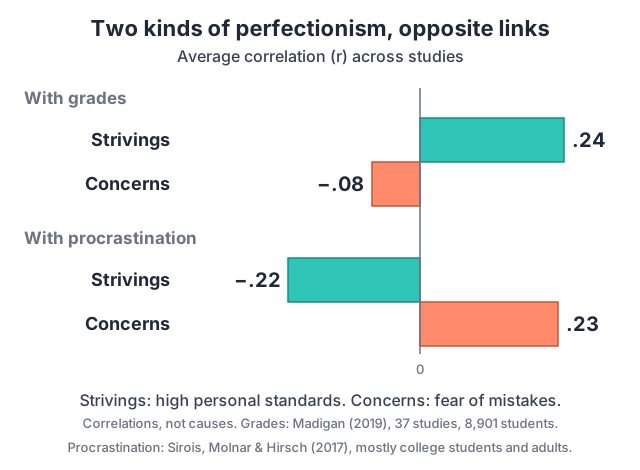
That second finding is worth sitting with, because it explains something that confuses a lot of parents. In my experience of reading about it, a child driven by perfectionistic concerns often does not look like a perfectionist at all. They look like they are not trying. They put the homework off. They refuse to start the drawing. They say the game is stupid. From the outside it reads as laziness or defiance. From the inside, not starting is the only sure way not to fail. If that sounds familiar, the pattern of anxiety showing up as defiance is something I wrote about in Why Your "Defiant" Kid Might Actually Be Anxious.
I want to be careful not to oversell the striving side. Some researchers argue it is healthy as long as the fear of mistakes is not attached to it.[1] The point for parents is narrower and more practical. The thing to watch for is not a kid who cares about doing well. It is a kid for whom a mistake feels like a threat.
Why the Fear Side Matters
Perfectionistic concerns are not just uncomfortable. They are tied, fairly consistently, to the kinds of struggles parents worry about most.
A meta-analysis of 284 studies found that both dimensions of perfectionism were associated with depression, anxiety, obsessive-compulsive disorder, eating disorders, and related problems.[4] Most of that research is in adults and university students, so it tells us more about where perfectionism can lead than about any particular child.
The longitudinal research is more telling, because it can show which comes first. One meta-analysis pooled 67 studies that followed more than 20,000 people over time. Perfectionistic concerns predicted later increases in depressive symptoms, and depressive symptoms predicted later increases in perfectionistic concerns.[5] It runs in both directions, which is a good description of how a cycle gets going. A smaller meta-analysis of 11 longitudinal studies, which included children and adolescents alongside adults, found that concern over mistakes and doubts about one's actions predicted small increases in anxiety later on, even after accounting for how anxious people were to begin with. High personal standards did too, though more weakly.[6]
In children and teenagers specifically, a 2023 meta-analysis of 39 studies with nearly 14,000 young people (average age about 14) found that perfectionism was linked to more eating disorder symptoms, with the fear-of-mistakes side showing the strongest link.[7] Most of those studies were snapshots taken at one point in time, so they cannot say which came first. A review focused on children concluded that perfectionism is understudied in childhood anxiety and depression but is beginning to look like an underlying process that contributes to both.[8]
None of this means a perfectionistic child is headed for a diagnosis. The links in these studies are mostly small to moderate. What it does mean is that the meltdown over a wrong answer is not a quirk to be waited out. It is worth paying attention to, and there are things that help.
Is It Really Getting More Common?
You may have seen headlines saying perfectionism is rising. That is based on real research, and it is worth knowing exactly what it measured.
Thomas Curran and Andrew Hill pooled 164 samples of more than 41,000 college students in the United States, Canada, and the United Kingdom who completed the same perfectionism questionnaire between 1989 and 2016.[9] All three forms they measured rose over that period: the demands young people placed on themselves, the demands they placed on others, and, rising the most, the sense that other people demand perfection from them.
Two things are important to keep in mind. These were college students, not young children, so the trend tells us about the generation, not directly about your second grader. And a rise in scores tells us what changed, not why.
The same authors went looking for the why. In a follow-up, they combined 21 studies, mostly of young adults, on how people perceived their parents.[10] Those who reported higher parental expectations and harsher parental criticism also scored higher on perfectionism. The link was small to moderate for the demands young people put on themselves, and large for the feeling that others demand perfection. Then they looked at whether those perceptions had changed over time. Between 1989 and 2019, college students' reports of their parents' expectations and criticism had both risen. Before their analysis, the authors described the evidence for a parenting explanation as limited and contested. After it, they called rising parental expectations and criticism the most plausible explanation to date for rising perfectionism.
That word "perceived" matters, and it is the part I keep coming back to. These studies measured what young people believed their parents expected, not what the parents said or intended. A parent can say "I just want you to do your best" and mean it sincerely, and a child can still hear "and your best had better be very good." What the research tracks is the message received.
Where Perfectionism Comes From
This is the part of the research that is hardest to read as a parent, so I want to say plainly up front: perfectionism is not something parents simply create. A study of about 1,000 female twins suggests genes play a part.[11] Temperament plays a part.[12] I would add that a child's own early experiences with success and failure play a part, and that kids absorb pressure from school, from peers, and from screens.
With that said, some parenting patterns keep showing up in the research, and they are worth knowing about because they are things we can change.
Taking over. The one long-term study of young children I found followed 302 children in Singapore from age 7 to age 11, using reports from parents and children plus direct observation of parents and children working on a task together.[12] Children whose parents were more intrusive and more negative were more likely to show high or rising levels of a self-critical kind of perfectionism over those years. Children with high levels of perfectionism early on also had more emotional and behavior problems. The other kind of perfectionism, the feeling that others demand perfection, was instead predicted by a temperament trait: how outgoing and high-energy the child was.
Expectations a child feels they cannot meet. A study of 381 teenagers aged 15 to 19 measured how high they felt their parents' expectations were, then measured perfectionism again seven to nine months later.[13] Teenagers who felt their parents had high expectations of them showed a rise in the feeling that other people demand perfection from them. This did not happen for the standards they set for themselves. In other words, feeling pressure from parents predicted a growing sense that people in general expect them to be perfect.
Love that seems to depend on performance. Researchers call this conditional regard: giving more warmth and approval when a child succeeds and withdrawing it, even subtly, when they do not. In studies of college students describing their parents, conditional regard went along with students doing more of what their parents wanted, but also with costs.[14] Those students reported a sense of inner compulsion, self-esteem that rose and fell, and resentment toward their parents. Two later studies of Israeli ninth graders found costs even for the positive version, where parents give extra affection after success rather than withdrawing it after failure.[15] Teenagers who reported more of it felt more internal pressure, and their engagement with school centered on grades, while teenagers whose parents supported their own choices and reasons showed more genuine interest in learning.
A parent's own perfectionism. A study of late-adolescent daughters and their parents found that parents with a more anxious, self-critical kind of perfectionism were more likely to use what researchers call psychological control, which means steering a child through their feelings (guilt, disappointment, love held back) rather than through rules.[16] That control was the statistical link between the parents' perfectionism and their daughters'. Because everyone was measured at one point in time, the study cannot show that one caused the other. I find that more hopeful than it sounds. Parents' high standards on their own did not predict control. The anxious, self-critical side of perfectionism did.
I will say again that almost every study here is correlational. Researchers measured parenting and perfectionism and found they move together, sometimes over time. That is strong enough to take seriously and not strong enough to say any one parent caused any one child's perfectionism. I think it is also likely that kids shape their parents. A child who is already anxious about mistakes can pull a parent into hovering, correcting, and reassuring, and it becomes hard to say where it started.
What Actually Helps
Here is the encouraging part. Perfectionism responds to help, and the methods that work are not mysterious.
The treatment with the most trial evidence I found is cognitive behavioral therapy aimed at perfectionism. A meta-analysis of 15 randomized trials with 912 participants found medium to large reductions in perfectionism, plus medium reductions in depression and eating disorder symptoms and a small to medium reduction in anxiety.[17] The average participant in those trials was about 23, so most of the evidence is from young adults.
Trials with teenagers are smaller but point the same way. In one trial of 94 young women aged 14 to 19 who described themselves as perfectionistic, an unguided online program focused on perfectionism did better than both a general stress-management program and a waitlist, with benefits lasting through six months.[18]
There are also school programs that teach the same ideas to whole classes, not just to kids who are struggling. Their results are modest, and their pattern is interesting. In a study of 688 students around age 15, a perfectionism and self-compassion program showed no difference right after it ended, but six months later those students had lower perfectionism, less self-criticism, and less negative mood than the comparison group.[19] At twelve months, the drop in perfectionism remained. A more recent trial in 636 students around age 13 to 14 used five lessons taught by regular classroom teachers.[20] Again, there was no difference right after the lessons. Three months later, anxiety had gone up in the comparison classes and not in the classes that had the lessons.
What did those lessons actually teach? I read the lesson plan because it is a useful window into what researchers think the active ingredients are. Students discussed what mistakes are good for. They talked about why rest improves performance and why working harder does not always mean doing better. They practiced writing a kind letter to a friend after a disappointment and then a kind letter to themselves. They compared a critical coach with an encouraging one and talked about which one gets better performance. And they talked about how social media shows everyone's perfect moments and none of the rest.[20]
That emphasis on self-compassion shows up in other research too. In a survey of 541 high school students, perfectionism was linked to depression, but the link was weaker in students who treated themselves with more kindness.[21] That was a single snapshot, so it cannot prove self-compassion protects, but it lines up with what the trials were trying to teach.
When the Standard Advice Doesn't Fit
A lot of perfectionism advice assumes a child who is mostly fine and a little too hard on themselves. Not every family fits that.
Kids whose brains work differently. Some children are rigid about how things should be for reasons that have more to do with how their brain processes the world than with fear of judgment. A child who needs the letter to look exactly right may be dealing with sensory or motor frustration, or with difficulty shifting gears, not a belief that they must be perfect. The research I read did not separate these out well, so I am not going to pretend it did. What I would say is that the practical steps below, lowering the stakes of mistakes and staying warm when things go wrong, are unlikely to hurt any child. If your child's rigidity is intense or tied to a diagnosis, the person treating them is the right one to help sort out which is which.
Kids who are already anxious. Perfectionism and anxiety are closely linked,[6] and I think the same traps apply. The biggest one is what researchers call accommodation: changing what the family does to spare the child distress. With perfectionism, that might mean redoing their work for them, letting them erase for an hour, or steering them away from anything they might not be good at. I think the logic from anxiety applies here too. Each time we remove the feared thing, the fear gets a little more confirmed. I wrote about how that works, and what to do instead, in The Accommodation Trap.
Kids moving between two homes. If your child splits time between households with different expectations, they may be managing two sets of standards, and a mistake can feel like it will be reported, compared, or judged in two places instead of one. The research on perfectionism does not study this directly. But everything above suggests the same goal applies in both homes: a mistake should not cost the child your warmth. You cannot control the other house. You can make yours a place where getting something wrong is safe.
Parents who are perfectionists themselves. If you recognized yourself in the section on where perfectionism comes from, you are in good company. The research points less at your standards and more at the anxious, self-critical side of perfectionism, and whether it shows up as control. Working on your own relationship with mistakes is not selfish. It may be one of the most direct things you can do for your child.
Letting Her Struggle
I have never finished something for my kids. If I can tell one of them is struggling too much, I will help with the task, but I let them struggle through things as much as possible first.
My oldest is a good example. She loves puzzle games, and one of ours is a gravity maze. Each puzzle starts with towers already on the board, and the game gives you the pieces you need to arrange to get a ball to the end point. You arrange them, twist them, and generally do whatever you can to reach the goal, and some of the puzzles are a real challenge.
I will help her come up with solutions, but I make it clear that it is okay, and encouraged, to try a solution just to see if it works. That gives her the comfort to fail time and time again until she finds the answer. Sometimes, when she keeps doing the same thing over and over, I give her some encouragement or a push in a different direction.
What To Do Instead
None of these are scripts. They are directions, each tied to what the research above found.
- Keep the standard, lower the stakes. You do not have to stop caring about good work. The research separates the wish to do well, which is mostly fine, from the fear of falling short, which is the problem.[1][2] The goal is a child who wants to do well and can survive not doing well. Watch your reaction to the mistake more than your praise of the success. I think a calm "okay, what happened there?" teaches more than any amount of praise afterward.
- Make your warmth unconditional, and obvious. The research on conditional regard suggests kids notice when affection rises and falls with performance, even when we think we are just celebrating.[14][15] Celebrate success, but make sure your warmth after a bad grade looks the same as your warmth after a good one. In one randomized study, simply having 11 to 15 year olds spend 15 minutes reflecting on times they felt accepted without conditions softened the shame and insecurity they felt after a bad grade three weeks later.[22] The setback came three weeks after a single fifteen-minute exercise, which tells you how much that feeling matters.
- Step back from the worksheet. The long-term study of young children above found that parental intrusiveness predicted high or rising self-critical perfectionism.[12] It is very hard to watch a child struggle when you could fix it in ten seconds. But taking over sends a message, even when we mean it kindly: that the child's own attempt was not good enough. Try sitting nearby instead of hovering. Ask before correcting. Let some mistakes stand.
- Read avoidance as fear before you read it as laziness. In studies of mostly college students and adults, perfectionistic concerns go with more procrastination.[3] A child who will not start the project may be protecting themselves from doing it badly. Naming that can help: "I wonder if it feels hard to start because you want it to be really good." Then make the first step smaller. Write one sentence. Draw one line. Done badly on purpose, if needed.
- Do not do it for them, even when they beg. Rewriting the page, finishing the drawing, or letting them quit everything they are not instantly good at all feel kind in the moment. I think they keep the fear going for the same reason accommodation keeps anxiety going. You can stay with your child in the discomfort without removing it.
- Teach the encouraging coach. The school programs above leaned heavily on self-compassion: noticing the critical voice and practicing a kinder one.[19][20] A survey of high school students also found the link between perfectionism and depression was weaker in those who were kinder to themselves.[21] At home that can be as simple as asking, "What would you say to a friend who got that wrong?" and then, "Could you say that to yourself?"
- Talk about your own mistakes, out loud. I believe kids learn what mistakes mean partly by watching us make them. When you burn dinner or miss a turn, saying "Oops, I messed that up, oh well" in a normal voice is a small lesson in surviving imperfection. If you are a perfectionist yourself, the research suggests the bigger risk is the anxious, self-critical side of it showing up as control, so it is worth watching for guilt, disappointment, or withdrawal when your child falls short.[16]
- Watch the inputs. The teen lessons spent a whole session on how social media shows only perfect moments.[20] You do not have to ban anything. Asking "do you think that is what their life actually looks like?" is a decent start.
The Good News
Perfectionism can change. The trials above show it responds to help, in young adults and in teenagers, sometimes with short programs.[17][18][19] A classroom program taught by ordinary teachers did not lower perfectionism overall, but it did keep anxiety from rising.[20] The effects were not always immediate. In both school trials, the benefits only showed up months later. That is worth remembering if you start making changes at home and do not see a difference right away.
And the simplest finding in this post is also one of the most hopeful. In that randomized study, a short reminder of being valued without conditions helped kids handle a real setback weeks later.[22] You can give your child that reminder every day.
When to Get Help
Plenty of kids with perfectionistic streaks never need professional help. Some do. Consider talking to your pediatrician or a child psychologist if:
- The perfectionism is taking up hours of your child's day: redoing work again and again, erasing until the paper tears, or being unable to finish because nothing is ever right.
- Your child is avoiding school, activities, or friendships because they are afraid of not doing well.
- The distress after a mistake is intense, frequent, or lasts a long time.
- You are seeing signs of anxiety, low mood, eating changes, or rituals that seem to be about getting things "just right."
- Your child talks about themselves in harsh, hateful terms after a mistake.
When you look for help, it is reasonable to ask whether the therapist uses cognitive behavioral therapy and has worked with perfectionism. That is the approach the trials above tested.[17]
If your child ever says they would rather not exist, or talks about hurting themselves after a failure, take it seriously and get help the same day. In studies of university students, medical students, community adults, and psychiatric patients, perfectionism and parental criticism and expectations have been linked to suicidal thoughts, and the feeling that others demand perfection predicted increases in those thoughts over time.[23] You can call or text the 988 Suicide & Crisis Lifeline at 988, any time, for advice on what to do next. If your child is in immediate danger, call 911.
If You're Reading This
If your child just melted down over a mistake: you are not overreacting by taking it seriously, and you have not missed your chance. Start with your reaction to the next mistake. That is where most of the change happens.
If you recognized yourself in the parenting research: most of us do, somewhere. The research is about patterns, not verdicts, and patterns can change. That you are reading this suggests you are already the kind of parent who will.
If you are a perfectionist yourself: being hard on yourself about being hard on your kids is the same pattern one level up. Try giving yourself the encouraging coach too.
If your child seems lazy, not perfectionistic: look again at the avoidance. Sometimes the kid who will not try is the one who cares the most.
The Bottom Line
High standards are not the main problem. The fear of falling short is. That fear is linked to anxiety, low mood, and more, and it seems to grow when kids feel love depends on performance, when adults take over their work, and when expectations feel impossible to meet. It shrinks when mistakes are safe, when warmth does not depend on results, and when kids learn to talk to themselves the way they would talk to a friend. You can keep caring about how your child does. Just make sure they know you care about them more.
Resources & Further Reading
- 988 Suicide & Crisis Lifeline (call or text 988, or chat at 988lifeline.org). Free, confidential, and available 24 hours a day, including for parents worried about a child.
- The classroom perfectionism lessons described above are laid out lesson by lesson in the open-access trial report by Osenk, Johnson and Wade.[20] If your child's school is interested, it is a practical place to start.
- Self-compassion and perfectionism in teens: the Ferrari et al. study is open access and readable for a parent who wants to go deeper.[21]
- Related posts on this site: Why Your "Defiant" Kid Might Actually Be Anxious and The Accommodation Trap.
References
↑ [1]: Stoeber, J., & Otto, K. (2006). "Positive conceptions of perfectionism: Approaches, evidence, challenges." Personality and Social Psychology Review, 10(4), 295-319. Available at: https://doi.org/10.1207/s15327957pspr1004_2
↑ [2]: Madigan, D. J. (2019). "A meta-analysis of perfectionism and academic achievement." Educational Psychology Review, 31(4), 967-989. Available at: https://doi.org/10.1007/s10648-019-09484-2
↑ [3]: Sirois, F. M., Molnar, D. S., & Hirsch, J. K. (2017). "A meta-analytic and conceptual update on the associations between procrastination and multidimensional perfectionism." European Journal of Personality, 31(2), 137-159. Available at: https://doi.org/10.1002/per.2098
↑ [4]: Limburg, K., Watson, H. J., Hagger, M. S., & Egan, S. J. (2017). "The relationship between perfectionism and psychopathology: A meta-analysis." Journal of Clinical Psychology, 73(10), 1301-1326. PMID 28026869. Available at: https://doi.org/10.1002/jclp.22435
↑ [5]: Smith, M. M., Sherry, S. B., Ray, C., Hewitt, P. L., & Flett, G. L. (2021). "Is perfectionism a vulnerability factor for depressive symptoms, a complication of depressive symptoms, or both? A meta-analytic test of 67 longitudinal studies." Clinical Psychology Review, 84, 101982. PMID 33556805. Available at: https://doi.org/10.1016/j.cpr.2021.101982
↑ [6]: Smith, M. M., Vidovic, V., Sherry, S. B., Stewart, S. H., & Saklofske, D. H. (2018). "Are perfectionism dimensions risk factors for anxiety symptoms? A meta-analysis of 11 longitudinal studies." Anxiety, Stress, & Coping, 31(1), 4-20. PMID 28980487. Available at: https://doi.org/10.1080/10615806.2017.1384466
↑ [7]: Bills, E., Greene, D., Stackpole, R., & Egan, S. J. (2023). "Perfectionism and eating disorders in children and adolescents: A systematic review and meta-analysis." Appetite, 187, 106586. PMID 37196843. Available at: https://doi.org/10.1016/j.appet.2023.106586
↑ [8]: Affrunti, N. W., & Woodruff-Borden, J. (2014). "Perfectionism in pediatric anxiety and depressive disorders." Clinical Child and Family Psychology Review, 17(3), 299-317. PMID 24481881. Available at: https://doi.org/10.1007/s10567-014-0164-4
↑ [9]: Curran, T., & Hill, A. P. (2019). "Perfectionism is increasing over time: A meta-analysis of birth cohort differences from 1989 to 2016." Psychological Bulletin, 145(4), 410-429. PMID 29283599. Available at: https://doi.org/10.1037/bul0000138
↑ [10]: Curran, T., & Hill, A. P. (2022). "Young people's perceptions of their parents' expectations and criticism are increasing over time: Implications for perfectionism." Psychological Bulletin, 148(1-2), 107-128. PMID 35357848. Available at: https://doi.org/10.1037/bul0000347
↑ [11]: Tozzi, F., Aggen, S. H., Neale, B. M., Anderson, C. B., Mazzeo, S. E., Neale, M. C., & Bulik, C. M. (2004). "The structure of perfectionism: a twin study." Behavior Genetics, 34(5), 483-494. PMID 15319571. Available at: https://doi.org/10.1023/B:BEGE.0000038486.47219.76
↑ [12]: Hong, R. Y., Lee, S. S. M., Chng, R. Y., Zhou, Y., Tsai, F. F., & Tan, S. H. (2017). "Developmental trajectories of maladaptive perfectionism in middle childhood." Journal of Personality, 85(3), 409-422. PMID 26919690. Available at: https://doi.org/10.1111/jopy.12249
↑ [13]: Damian, L. E., Stoeber, J., Negru, O., & Băban, A. (2013). "On the development of perfectionism in adolescence: Perceived parental expectations predict longitudinal increases in socially prescribed perfectionism." Personality and Individual Differences, 55(6), 688-693. Available at: https://doi.org/10.1016/j.paid.2013.05.021
↑ [14]: Assor, A., Roth, G., & Deci, E. L. (2004). "The emotional costs of parents' conditional regard: a self-determination theory analysis." Journal of Personality, 72(1), 47-88. PMID 14686884. Available at: https://doi.org/10.1111/j.0022-3506.2004.00256.x
↑ [15]: Roth, G., Assor, A., Niemiec, C. P., Deci, E. L., & Ryan, R. M. (2009). "The emotional and academic consequences of parental conditional regard: comparing conditional positive regard, conditional negative regard, and autonomy support as parenting practices." Developmental Psychology, 45(4), 1119-1142. PMID 19586183. Available at: https://doi.org/10.1037/a0015272
↑ [16]: Soenens, B., Elliot, A. J., Goossens, L., Vansteenkiste, M., Luyten, P., & Duriez, B. (2005). "The intergenerational transmission of perfectionism: parents' psychological control as an intervening variable." Journal of Family Psychology, 19(3), 358-366. PMID 16221016. Available at: https://doi.org/10.1037/0893-3200.19.3.358
↑ [17]: Galloway, R., Watson, H., Greene, D., Shafran, R., & Egan, S. J. (2022). "The efficacy of randomised controlled trials of cognitive behaviour therapy for perfectionism: a systematic review and meta-analysis." Cognitive Behaviour Therapy, 51(2), 170-184. PMID 34346282. Available at: https://doi.org/10.1080/16506073.2021.1952302
↑ [18]: Shu, C. Y., Watson, H. J., Anderson, R. A., Wade, T. D., Kane, R. T., & Egan, S. J. (2019). "A randomized controlled trial of unguided internet cognitive behaviour therapy for perfectionism in adolescents: Impact on risk for eating disorders." Behaviour Research and Therapy, 120, 103429. PMID 31279221. Available at: https://doi.org/10.1016/j.brat.2019.103429
↑ [19]: Nehmy, T. J., & Wade, T. D. (2015). "Reducing the onset of negative affect in adolescents: evaluation of a perfectionism program in a universal prevention setting." Behaviour Research and Therapy, 67, 55-63. PMID 25747974. Available at: https://doi.org/10.1016/j.brat.2015.02.007
↑ [20]: Osenk, I., Johnson, C., & Wade, T. D. (2023). "A pragmatic randomized controlled trial targeting perfectionism in young adolescents." School Mental Health, 15(1), 151-164. PMID 36092281. DOI 10.1007/s12310-022-09540-3. Available at: https://pmc.ncbi.nlm.nih.gov/articles/PMC9446653/
↑ [21]: Ferrari, M., Yap, K., Scott, N., Einstein, D. A., & Ciarrochi, J. (2018). "Self-compassion moderates the perfectionism and depression link in both adolescence and adulthood." PLoS ONE, 13(2), e0192022. PMID 29466452. Available at: https://doi.org/10.1371/journal.pone.0192022
↑ [22]: Brummelman, E., Thomaes, S., Walton, G. M., Poorthuis, A. M., Overbeek, G., Orobio de Castro, B., & Bushman, B. J. (2014). "Unconditional regard buffers children's negative self-feelings." Pediatrics, 134(6), 1119-1126. PMID 25367539. Available at: https://doi.org/10.1542/peds.2013-3698
↑ [23]: Smith, M. M., Sherry, S. B., Chen, S., Saklofske, D. H., Mushquash, C., Flett, G. L., & Hewitt, P. L. (2018). "The perniciousness of perfectionism: A meta-analytic review of the perfectionism-suicide relationship." Journal of Personality, 86(3), 522-542. PMID 28734118. Available at: https://doi.org/10.1111/jopy.12333
Tags
Written by
Steadykeep
Published
November 3, 2026