The Homework Battle That Is Not Worth Winning: What the Research Says About Helping (and Not Helping)
How much you help with homework predicts very little. How you help matters more. What decades of research say about homework, parent help and the nightly fight.
When my oldest first started school, before my divorce was final, she struggled to focus on her homework. She would skip sections, ignore the instructions, or invent instructions of her own. I often had to sit down with her, either to check her homework or to be with her while she did it and help her through it.
Why I Started Looking at the Research
If you have searched "homework fights every night" or "how much should I help with homework", you have probably found two kinds of answer. One kind says homework is pointless and you should let it go. The other kind gives you a routine: a quiet desk, a fixed time, a timer, a sticker chart, and you sitting beside them until it is done.
Neither fit what I wanted to know. I was not asking whether homework is good or bad in the abstract. I was asking a narrower question that I suspect a lot of parents are asking at the kitchen table: when my kid is stuck and miserable, does it help for me to sit down and push through it with them, or am I making it worse?
It turns out researchers have been asking that exact question for decades, and the answer is more useful than either camp's slogan. The short version is that homework itself does some good, with a stronger link for older kids than younger ones. How much a parent helps tells you very little. How the parent helps tells you more. And I suspect the version of help that comes most naturally at 8pm, when everyone is tired and the clock is running, is close to the version the research looks least kindly on.
That last part is not an accusation. It is the most useful thing I found, because it means the fix is not more effort from you. In a lot of cases it is less.
What Homework Actually Does, by Age
Start with the question underneath the fight: is the homework worth it at all?
A major review of the US research, by Harris Cooper and colleagues, pulled together studies from 1987 to 2003.[1] The authors were blunt that every study they found had design flaws. Even so, across different kinds of studies, they found generally consistent evidence that homework has a positive influence on achievement. The important detail is where that link was strongest. In studies that simply correlated homework with achievement, the relationship was stronger in grades 7 to 12 than in kindergarten through grade 6.
So homework is not useless, and I am not going to tell you it is. But for younger children the link between homework and how well they do in school is weaker, and the research gives less reason to spend an hour of a seven-year-old's evening fighting over it than it does for a fourteen-year-old.
Cooper also recommends a guideline you may have heard from a teacher, the "10-minute rule". In his university's own summary of his advice, it reads as roughly 10 minutes a night in first grade, 20 in second, 30 in third, and so on, with the benefit for junior high students appearing to disappear after about 90 minutes a night.[2] It is a rule of thumb, not a finding from a trial, but it is a useful reference point to bring to a conversation with a teacher.
Time on the clock is not the thing that matters
The more interesting finding is that once researchers account for who the students are, time spent on homework says surprisingly little about how well a particular child does.
A study of 231,759 students in 40 countries, using the PISA 2003 international math assessment, found that schools where students spent more time on homework, on average, did tend to have higher math scores, but that the link shrank considerably once family background and school track were taken into account. At the level of individual students, there was no clear-cut relationship between homework time and achievement.[3]
A Spanish study of 7,451 adolescents (average age about 14) looked inside the homework itself.[4] Prior grades were by far the strongest predictor of test results. Among the homework variables, the one that mattered most for an individual student was not time and not effort. It was autonomy: whether the student did the homework on their own. The authors put the optimum at about one hour a day for that age group.
Put those together and a picture forms. Hours at the table do not reliably go with higher scores. A child working through problems on their own, for a reasonable amount of time, goes with better results.
The Myth: More Help Means Better Results
This is the part most likely to surprise you.
If you line up families by how much the parents help with homework, the children who get the most help tend to do slightly worse, not better. That pattern shows up in several large studies:
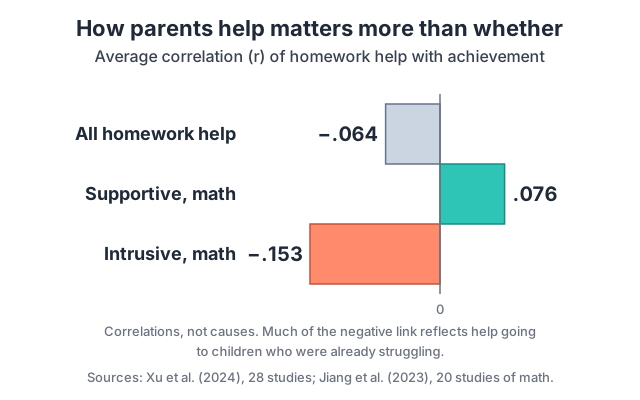
- A 2024 meta-analysis of 28 studies, covering 378,222 participants, found an overall weak negative relationship between parental homework involvement and achievement, although how often parents helped was, on its own, largely unrelated to achievement.[5]
- A meta-analysis of PISA results from 2009 to 2018 found that students who had more help with homework had lower academic achievement, and that this held across subjects and was stable over time.[6]
- A longitudinal study of 1,685 sixth graders found that how often parents helped was negatively associated with the development of their achievement.[7]
Before anyone reads that as "helping your kid makes them worse at school", stop. The research shows that at least part of this runs the other way.
Help follows struggle
A study that followed 2,261 children from first grade to fourth grade, with questionnaires from 1,476 of their mothers, is the clearest on this.[8] Children who were doing poorly in first grade later drew more help, more monitoring and more negative feelings from their mothers in homework situations. Children who were doing well drew more positive feelings, and their mothers saw them as able to work on their own.
That study also found the other direction: the more help mothers reported, the slower their children's reading and math developed between grades 1 and 4, especially when the mothers saw their child as unable to work autonomously. So it goes both ways. Struggling kids get more help, and more help went with slower progress afterwards, so the two can feed each other.
The sixth-grade study above makes the same point from another angle: the apparent effects of homework help were overestimated whenever the researchers failed to account for children's prior achievement and family background.[7]
The honest summary is that "how much do you help?" is close to the wrong question. The number of evenings you spend at the table is partly a marker of which kids were already finding school hard.
What Actually Matters: How You Help
When researchers stop counting how often parents help and start asking what that help is like, the results get much clearer.
The same 2024 meta-analysis that found the overall slightly negative link split involvement into kinds. Of all the kinds of help they could separate, autonomy support was the only one positively related to achievement. Help with the content itself, parental control and frequency of help were largely unrelated to it.[5]
A separate 2023 meta-analysis, of 20 studies and 16,338 students, focused on math.[9] It found a small positive link between supportive involvement and math achievement, strongest when that support took the form of autonomy support. It found a negative link, about twice the size, between intrusive involvement and math achievement.
The individual studies say the same thing in plainer terms:
- In the sixth-grade study, homework help that children perceived as supportive predicted better achievement over time. Help they perceived as intrusive predicted worse.[7]
- In a study of 282 fifth and eighth graders and one of their parents, autonomy support was the most beneficial kind of homework involvement. Parents' control and interference were predicted by their performance goals for their child and by how capable they believed their child to be.[10]
- In a study of mothers and their adolescents moving into lower secondary school, mothers' psychological control and monitoring that the mother started (rather than the child asking for it) were linked to poorer later achievement, partly through more task avoidance by the adolescent. Poor earlier achievement also went with more of that controlling involvement, which is the loop again.[11]
What "autonomy support" looks like at a kitchen table
The phrase sounds abstract, so here is my translation of what the studies mean by it. Autonomy-supportive help leaves the child in charge of the work. You are available. You ask what they think the question wants. You help them find where they got lost rather than showing them the answer. You let them choose the order, take a break, or try a wrong method and find out it is wrong. You acknowledge that the task is boring or hard when it is.
Intrusive or controlling help is the opposite: hovering, correcting each line as it is written, taking the pencil, doing the problem "so they can see", checking every answer before they hand it in, or making your approval depend on getting it right.
None of the controlling behaviors come from bad parents. They tend to come from parents who are tired, worried about the grade, and watching the clock; in one study, parents' control was predicted by their focus on performance for their child.[10] In the studies above, controlling help showed up more with kids who were already struggling.[11][14]
The feeling in the room travels
Homework is an emotional task as well as a thinking one, for both people at the table.
A study of 483 American parents of young elementary school children had them report on their involvement in math every day for 12 days.[12] Involvement in homework was more emotionally negative than involvement in other math activities, especially for parents who doubted their own ability to help. The more negative that involvement was, the poorer children's later math motivation and achievement.
Math anxiety in parents is a specific version of this. In a large study of first and second graders, children of math-anxious parents learned less math over the school year and ended the year more anxious about math, but only when those parents reported helping frequently with math homework.[13] When they helped less often, their anxiety was not linked to how their children did. A later study of 562 parents of young elementary children found that math-anxious parents were more controlling with children who were already behind in math, and that this controlling involvement predicted lower math achievement a year later.[14]
If math makes you tense, that is not a reason to feel guilty. It is a reason to know that your tension can be part of what gets handed over at the table, and to adjust how you show up rather than how often.
Involvement is still a good thing
I want to be careful here, because there is a tempting wrong conclusion: "the research says stay out of it." It does not.
In a study of 825 American and Chinese seventh and eighth graders, parents' heightened involvement in their children's learning predicted better engagement and achievement in both countries.[15] Parents being interested, available and on their child's side goes with better outcomes. The problem is a particular style of homework help, not parents caring about school.
The Boring Fundamentals That Actually Help
The well-supported basics are unglamorous, which is probably why they are hard to find online.
Set the structure, not the answers. In the big 2008 review of parent involvement in homework, the strongest association was with rule-setting, compared with the other ways parents were involved.[16] I read rule-setting as the routine around homework (when and where it happens) rather than teaching the content. In the research on parental structure it is defined as clear, consistent and predictable rules and expectations,[24] which is different from control. You decide that homework happens after a snack at the kitchen table. Your child decides how to go about it.
Help can be taught, and it works. The same review pooled 14 studies that trained parents in how to be involved in homework. Training led to higher homework completion, fewer homework problems and possibly better performance among elementary school children.[16] A smaller study of 37 parents who went through a four-session program on autonomy-supportive help found that the training reduced parents' negative feelings during homework, kept children's negative feelings from rising, and kept their motivation for homework steady.[17]
Watch the load. In a survey that measured homework against the 10-minute rule, family stress rose as homework load went up and as parents felt less able to help, and primary school children were getting about three times the recommended amount.[18] At the other end of school, a study of 4,317 students in 10 high-performing high schools in upper-middle-class communities found an average of more than three hours of homework a night. Students who did more hours were more engaged in school, and also reported more academic stress, more physical health problems and less balance in their lives.[19] More is not automatically better at either age.
Expect the role to change with age. In one study of 1,683 students in grades 5 to 10, parental homework involvement as the students perceived it was linked to their homework behavior in junior high and high school, but not in grades 5 and 6.[20] The 2008 review similarly found the pattern of associations shifted across elementary, middle and high school.[16] What a seven-year-old needs from you and what a fourteen-year-old needs are different jobs.
When the Standard Advice Doesn't Fit
Kids with ADHD
"Let them work on their own" is easy to say about a child whose brain lets them sit down, start, and keep going. For a lot of children with ADHD, starting, organizing and finishing are the hard part, which is why the trials below target homework and organization directly. Stepping back and hoping is not the answer for them, but neither is doing it for them. The research points to teaching those skills directly.
- In the large MTA treatment study of 579 children aged 7 to 9 with ADHD, only the children who received behavioral treatment (on its own or combined with medication) showed sustained improvement in homework problems compared with routine community care.[21]
- In a trial of 199 children in grades 2 to 6 with ADHD, a 12-week family-school program that included daily report cards, behavioral homework strategies and joint planning between parents and teachers improved homework performance, parenting behavior and the quality of the family-school relationship compared with a program controlling for general support.[22]
- In a trial of 280 middle school students with ADHD, two brief school-based programs, run by school mental health staff in sessions averaging under 20 minutes, led to large improvements in parent-rated homework problems and organizational skills compared with a waitlist.[23] One of them, HOPS (Homework, Organization, and Planning Skills), also improved how organized students were in class, by teachers' ratings.
The common thread is that the school is part of the answer. In two of these three trials the program either ran through the school or brought teachers in directly, which is one more reason the kitchen table should not be where this battle is fought alone.
Two households
Moving between homes adds a layer. The worksheet is at the other house. One home does homework right after school and the other does it before bed. One parent checks every problem and the other never looks.
I could not find research on homework across two households specifically. What there is, in a study of 103 seventh graders, is evidence that parental structure (clear, consistent, predictable rules and expectations) went with a stronger sense of competence and control and fewer behavior problems, even after accounting for disruptive life events and transitions such as changes of residence.[24] That points in a sensible direction, and it is my view rather than a tested finding: agree, if you can, on a few predictable basics across both homes (where the folder lives, roughly when homework happens) and let the rest go. A child does not need two identical homework regimes. They need to know what to expect in each. I wrote more about activities and schedules across two homes in Can My Kid Do Activities If I Only Have Them Every Other Week?.
Kids for whom homework is a fear, not a chore
Some children avoid homework because they are scared of getting it wrong, not because they do not care. If the refusal looks like defiance but feels like panic, Why Your "Defiant" Kid Might Actually Be Anxious covers that pattern, and The Accommodation Trap covers why rescuing an anxious kid from every hard task can keep the fear going.
Homework in My House Now
I do not have a story about doing too much. I try not to do more than I should, and I do my best to help only as much as my daughter needs.
Under our current custody arrangement I do not usually do homework with the girls, but we do little projects, puzzles and worksheets. When we do, I point them down the right path without doing too much, and I try to keep things on their level.
What To Do Instead
- Separate the structure from the work. Decide with your child when and where homework happens, and keep it predictable. Then hand the work itself back to them. In the 2008 review, rule-setting had a stronger link to achievement than the other kinds of involvement,[16] and it is the part that is genuinely your job.
- Be available, not alongside. Sit nearby doing something of your own rather than across the table watching. A child who knows they can ask is in a different position from a child who is being supervised. Help the child asked for is different from monitoring the parent started: in one study of young adolescents, monitoring the mother started went with poorer later achievement.[11]
- Ask before you tell. When they are stuck, ask what the question is asking, what they have tried, and where it stopped making sense. Point to the step where it went wrong instead of showing the right answer. This is what autonomy support looks like in practice, and in both recent meta-analyzes it was the kind of help most clearly linked to better achievement.[5][9]
- Let mistakes go back to school. A worksheet with errors in it shows the teacher what your child does not yet understand. A worksheet you corrected hides it. In my view, checking every answer before it goes in is the sort of help that easily feels intrusive, and help children perceived as intrusive predicted worse achievement in the sixth-grade study.[7]
- Notice your own temperature. If you are tense about the subject, the grade or the clock, help less often and more lightly, or hand that subject to someone calmer. Frequent help[13] and controlling help[14] from a math-anxious parent are where the math-anxiety findings concentrate.
- Use a time limit and stop at it. Agree on a reasonable amount of time for the age, using the 10-minute rule as a starting point.[2] When time is up, stop, and let the work go back unfinished with a short note. In the research above, working on their own mattered more than time spent, and more time at the table did not reliably go with higher scores.[3][4]
- Tell the teacher what you are seeing. Before you write, Cooper's own advice is to check whether your child is using the time well.[2] If they are working steadily and it still takes far longer than it should, the teacher needs to know, because that is information about the assignment or about your child that they cannot see from the classroom.
- Make the emotional part as important as the work. When the evening is going badly, name it ("this one is really frustrating"), take a break, and come back. The research on negative feelings around homework suggests a calmer table matters for motivation and later achievement as well as for everyone's evening.[12][17]
The Good News
Two findings in this research are genuinely encouraging.
The first is that the way parents help is learnable. Parent training studies improved homework completion and reduced homework problems,[16] and a short program in autonomy-supportive help reduced parents' own negative feelings during homework while keeping children's motivation steady.[17] This is a skill, and it can be learned.
The second is that the most useful change often means doing less. You do not have to become a tutor. You do not have to master fourth-grade math as it is taught now. The research suggests a parent who sets a predictable routine, stays warm and available, and lets the child own the work is doing the most helpful version of the job.
When to Get Help
Homework trouble is common and usually not a sign of anything wrong. But some patterns are worth raising with the school or your child's doctor:
- Homework regularly takes far longer than the 10-minute guideline for their grade, even when your child is working steadily.
- Your child can do the work when you sit with them and cannot start or keep going without you, week after week.
- Reading, writing or math are persistently much harder for them than for classmates, despite real effort.
- Homework brings tears, stomach aches or panic most nights, or your child avoids school because of it.
- Trouble with focus, organization or starting tasks shows up everywhere, not only at homework time.
In the United States, a parent can ask their child's public school for an evaluation to find out whether the child has a disability that calls for special education. Under the federal special education rules, either a parent or the school can request that initial evaluation, and once the parent consents it must be done within 60 days or within the timeline the state sets.[25] Putting the request in writing gives you a record of when you asked. The 60-day clock itself starts when the school receives your consent to the evaluation, not when you first ask.
If You're Reading This
If homework is a nightly war at your house: the fight itself is a sign that something about the setup is not working, not that you are failing. Try changing the structure (a fixed time, a time limit, a nearby rather than alongside seat) before you try harder.
If you are the parent who does a lot of the helping: you are probably doing it because your child is struggling, and the research says that is exactly where help gets pulled in. The question is whether the help is building their independence or standing in for it.
If you are tense about math or a subject you struggled with yourself: that is extremely common, and it is not a flaw. Help less often, keep it light, or pass that subject to another adult, and let the teacher do the teaching.
If your child has ADHD or another learning difference: stepping back is not the whole answer. Ask the school about homework, organization and planning support; most of the programs that worked in trials were built to involve the school.
If you are co-parenting across two homes: aim for a few shared basics rather than an identical system, and keep homework out of the conflict between the adults.
The Bottom Line
Homework does some good, with a stronger link for older kids than younger ones. How much you help predicts very little, partly because help goes to the kids who are already struggling. How you help matters more: help that leaves your child in charge of the work goes with somewhat better results, and help that takes over goes with worse, though both links are modest on average. Set the routine, stay warm and available, let mistakes go back to school, and stop when the time is up. Most homework battles are not worth winning, because winning usually means you did the work.
Resources & Further Reading
- Talk to the teacher first. It is the single most useful step for a homework problem that will not go away, and it costs nothing.
- For parents of children with ADHD: the family-school program described above is described in the trial report by Power and colleagues,[22] and the HOPS and CHIEF school programs in Langberg and colleagues' trial.[23] Either is worth naming at a school meeting.
- Requesting an evaluation: the text of the federal rule on initial evaluations is short and readable.[25]
- Related posts on this site: Why Your "Defiant" Kid Might Actually Be Anxious, The Accommodation Trap and Can My Kid Do Activities If I Only Have Them Every Other Week?.
References
↑ [1]: Cooper, H., Robinson, J. C., & Patall, E. A. (2006). "Does homework improve academic achievement? A synthesis of research, 1987-2003." Review of Educational Research, 76(1), 1-62. Available at: https://doi.org/10.3102/00346543076001001
↑ [2]: Hartsoe, S. (2009, August 11). "Back to school, kids." Duke Today, Duke University. Harris Cooper on the 10-minute rule. Available at: https://today.duke.edu/2009/08/backtoschool.html
↑ [3]: Dettmers, S., Trautwein, U., & Lüdtke, O. (2009). "The relationship between homework time and achievement is not universal: evidence from multilevel analyses in 40 countries." School Effectiveness and School Improvement, 20(4), 375-405. Available at: https://doi.org/10.1080/09243450902904601
↑ [4]: Fernández-Alonso, R., Suárez-Álvarez, J., & Muñiz, J. (2015). "Adolescents' homework performance in mathematics and science: Personal factors and teaching practices." Journal of Educational Psychology, 107(4), 1075-1085. Available at: https://doi.org/10.1037/edu0000032
↑ [5]: Xu, J., Guo, S., Feng, Y., Ma, Y., Zhang, Y., Núñez, J. C., & Fan, H. (2024). "Parental homework involvement and students' achievement: A three-level meta-analysis." Psicothema, 36(1), 1-14. PMID: 38227295. Available at: https://doi.org/10.7334/psicothema2023.92
↑ [6]: Fernández-Alonso, R., Álvarez-Díaz, M., García-Crespo, F. J., Woitschach, P., & Muñiz, J. (2022). "Should we help our children with homework? A meta-analysis using PISA data." Psicothema, 34(1), 56-65. PMID: 35048896. Available at: https://doi.org/10.7334/psicothema2021.65
↑ [7]: Moroni, S., Dumont, H., Trautwein, U., Niggli, A., & Baeriswyl, F. (2015). "The need to distinguish between quantity and quality in research on parental involvement: The example of parental help with homework." The Journal of Educational Research, 108(5), 417-431. Available at: https://doi.org/10.1080/00220671.2014.901283
↑ [8]: Silinskas, G., Kiuru, N., Aunola, K., Lerkkanen, M.-K., & Nurmi, J.-E. (2015). "The developmental dynamics of children's academic performance and mothers' homework-related affect and practices." Developmental Psychology, 51(4), 419-433. PMID: 25798959. Available at: https://doi.org/10.1037/a0038908
↑ [9]: Jiang, Q., Shi, L., Zheng, D., & Mao, W. (2023). "Parental homework involvement and students' mathematics achievement: a meta-analysis." Frontiers in Psychology, 14, 1218534. PMID: 37519352. Available at: https://doi.org/10.3389/fpsyg.2023.1218534
↑ [10]: Gonida, E. N., & Cortina, K. S. (2014). "Parental involvement in homework: relations with parent and student achievement-related motivational beliefs and achievement." British Journal of Educational Psychology, 84(3), 376-396. PMID: 24905081. Available at: https://doi.org/10.1111/bjep.12039
↑ [11]: Tunkkari, M., Aunola, K., Hirvonen, R., Silinskas, G., & Kiuru, N. (2021). "The interplay between maternal homework involvement, task-avoidance, and achievement among adolescents." Journal of Family Psychology, 35(7), 863-874. PMID: 33630630. Available at: https://doi.org/10.1037/fam0000686
↑ [12]: Wu, J., Barger, M. M., Oh, D. D., & Pomerantz, E. M. (2022). "Parents' daily involvement in children's math homework and activities during early elementary school." Child Development, 93(5), 1347-1364. PMID: 35435993. Available at: https://doi.org/10.1111/cdev.13774
↑ [13]: Maloney, E. A., Ramirez, G., Gunderson, E. A., Levine, S. C., & Beilock, S. L. (2015). "Intergenerational effects of parents' math anxiety on children's math achievement and anxiety." Psychological Science, 26(9), 1480-1488. PMID: 26253552. Available at: https://doi.org/10.1177/0956797615592630
↑ [14]: Oh, D. D., Barger, M. M., & Pomerantz, E. M. (2022). "Parents' math anxiety and their controlling and autonomy-supportive involvement in children's math learning: Implications for children's math achievement." Developmental Psychology, 58(11), 2158-2170. PMID: 35951395. Available at: https://doi.org/10.1037/dev0001422
↑ [15]: Cheung, C. S., & Pomerantz, E. M. (2011). "Parents' involvement in children's learning in the United States and China: implications for children's academic and emotional adjustment." Child Development, 82(3), 932-950. PMID: 21418057. Available at: https://doi.org/10.1111/j.1467-8624.2011.01582.x
↑ [16]: Patall, E. A., Cooper, H., & Robinson, J. C. (2008). "Parent involvement in homework: A research synthesis." Review of Educational Research, 78(4), 1039-1101. Available at: https://doi.org/10.3102/0034654308325185
↑ [17]: Moè, A., Katz, I., & Alesi, M. (2018). "Scaffolding for motivation by parents, and child homework motivations and emotions: Effects of a training programme." British Journal of Educational Psychology, 88(2), 323-344. PMID: 29508390. Available at: https://doi.org/10.1111/bjep.12216
↑ [18]: Pressman, R. M., Sugarman, D. B., Nemon, M. L., Desjarlais, J., Owens, J. A., & Schettini-Evans, A. (2015). "Homework and family stress: With consideration of parents' self confidence, educational level, and cultural background." The American Journal of Family Therapy, 43(4), 297-313. Available at: https://doi.org/10.1080/01926187.2015.1061407
↑ [19]: Galloway, M., Conner, J., & Pope, D. (2013). "Nonacademic effects of homework in privileged, high-performing high schools." The Journal of Experimental Education, 81(4), 490-510. Available at: https://doi.org/10.1080/00220973.2012.745469
↑ [20]: Núñez, J. C., Suárez, N., Rosário, P., Vallejo, G., Valle, A., & Epstein, J. L. (2015). "Relationships between perceived parental involvement in homework, student homework behaviors, and academic achievement: differences among elementary, junior high, and high school students." Metacognition and Learning, 10(3), 375-406. Available at: https://doi.org/10.1007/s11409-015-9135-5
↑ [21]: Langberg, J. M., Arnold, L. E., Flowers, A. M., Epstein, J. N., Altaye, M., Hinshaw, S. P., et al. (2010). "Parent-reported homework problems in the MTA study: evidence for sustained improvement with behavioral treatment." Journal of Clinical Child and Adolescent Psychology, 39(2), 220-233. PMID: 20390813. Available at: https://doi.org/10.1080/15374410903532700
↑ [22]: Power, T. J., Mautone, J. A., Soffer, S. L., Clarke, A. T., Marshall, S. A., Sharman, J., et al. (2012). "A family-school intervention for children with ADHD: results of a randomized clinical trial." Journal of Consulting and Clinical Psychology, 80(4), 611-623. PMID: 22506793. Available at: https://doi.org/10.1037/a0028188
↑ [23]: Langberg, J. M., Dvorsky, M. R., Molitor, S. J., Bourchtein, E., Eddy, L. D., Smith, Z. R., et al. (2018). "Overcoming the research-to-practice gap: A randomized trial with two brief homework and organization interventions for students with ADHD as implemented by school mental health providers." Journal of Consulting and Clinical Psychology, 86(1), 39-55. PMID: 29172596. Available at: https://doi.org/10.1037/ccp0000265
↑ [24]: Flamm, E. S., & Grolnick, W. S. (2013). "Adolescent adjustment in the context of life change: the supportive role of parental structure provision." Journal of Adolescence, 36(5), 899-912. PMID: 24011106. Available at: https://doi.org/10.1016/j.adolescence.2013.07.006
↑ [25]: Initial evaluations, 34 C.F.R. § 300.301. Electronic Code of Federal Regulations. Available at: https://www.ecfr.gov/current/title-34/section-300.301
Tags
Written by
Steadykeep
Published
November 5, 2026