Why Kids Lie (And What Actually Makes Them Tell You the Truth)
Most children lie, starting around age two or three. Here is what decades of research say about why, why harsher punishment tends to produce more and better lies, and what actually makes honesty more likely at home.
Not long ago, right after I picked up my oldest daughter, she saw a park and wanted to go play. I told her we couldn't, because we had to go get dinner. She told me that her mom never takes her to the park.
I had to stop and think about where that came from, because I knew it wasn't true. Earlier that same week, a phone call with the kids had ended early because they were at a park playing. So I simply corrected her, and we talked about how we don't lie to each other and how lies hurt people. I want my kids to understand how important it is to tell the truth, and that they will never get in trouble for telling me the truth. If they break something, they can come talk to me about it. The truth matters that much between a parent and a child.
Why I Started Looking at the Research
If you have typed something like "my child lies all the time" or "why does my kid lie to my face" into a search bar, you have probably found two kinds of answer. One tells you lying is a red flag, that it starts small and grows, and that you need to come down hard now. The other tells you every child lies, it is a phase, and you should not worry about it. Neither one tells you what to actually say in the moment, and neither one shows you any evidence.
There is a lot of evidence. Developmental psychologists have been studying children's lies for decades, mostly with a simple and slightly sneaky experiment. A child is left alone in a room with a toy behind them and told not to turn around and look. Most of them look. Then an adult comes back and asks, "Did you peek?" A hidden camera records what the child did, so the researchers know the true answer before the child speaks. Many studies have used versions of that setup, with children from two years old to sixteen.
What came out of that work surprised me. Lying turns out to be a sign that a child's thinking is developing normally. The things most parents reach for to stop it, like a stern lecture, a scary story, or a bigger punishment for the lie, mostly do not work, and the evidence on punishment points the other way. And the thing that does seem to work is unglamorous. It comes down to how expensive the truth is in your house.
This post is about what the research says lying is, why children do it, what makes it worse, what makes honesty more likely, and the much smaller set of situations where lying is a sign that something else needs attention.
I want to say one thing up front. If your kid lies to you, it does not mean you have raised a dishonest person, and it does not mean you have failed. In many of these studies, more than half of the ordinary children who peek go on to lie about it the very first time they are asked. That is the starting point for everyone.
What Is Actually Happening When a Child Lies
Lying starts earlier than most parents think
In one study, Angela Evans and Kang Lee tested 65 children between two and three years old with the "do not peek" setup. Eighty percent peeked. When asked about it, about a quarter of the two-year-olds who had peeked denied it, while most of the three-year-olds who had peeked did.[1] So the first lies show up around a child's second birthday and become common within the following year.
Those early lies are not very good. When the researchers asked a follow-up question, "What do you think the toy is?", most of the little liars named the toy they claimed not to have seen.[1] The same thing happens with older children. In a study of 3- to 8-year-olds from a North American city, 82% of children peeked and 64% of the peekers lied about it. Of those who lied, 72% then blurted out the toy's name when asked.[2] They know enough to deny the deed. They do not yet know enough to hide what the deed taught them.
After that the curve keeps rising. A survey of 1,005 people aged 6 to 77 found that how often people said they lied rose through childhood, peaked in adolescence and fell through adulthood.[3] That was a single snapshot of different people at different ages, relying on what they reported about themselves, so it cannot show one person's path over time. But it matches what most parents of teenagers would guess.
Why lying is a sign of a developing mind
To tell a lie, a child has to understand something quite sophisticated: that you do not know what they know, and that what you believe can be different from what is true. Psychologists call that understanding "theory of mind." A lie also takes self-control. The child has to hold back the true answer that is sitting right there, and keep the false story straight.
So it makes sense that the studies keep finding links between lying and these thinking skills. In the 2-to-3-year-olds above, children with stronger executive function (the set of skills that includes self-control and working memory) were more likely to lie, even after accounting for age.[1] In the 3-to-8-year-olds, children's first denials were linked to their grasp of other people's beliefs and to their inhibitory control, and their ability to keep the lie going was linked to a more advanced kind of belief understanding.[2]
Two meta-analyses have pooled this work. One combined 81 studies of 7,826 children aged 2 to 14 from 14 cultures and found a small but reliable positive link between lying and theory of mind (r = .23), strongest for the ability to keep a lie going.[4] The other combined 47 papers with 5,099 participants and found small positive links between lying and both theory of mind (r = .17) and executive function (r = .13).[5] Small is the right word. These skills are one piece of why some children lie more than others, not the whole story.
The most striking study goes one step further. Researchers in China worked with three-year-olds who could not yet lie in a hide-and-seek deception game. Some of the children were given six sessions of training in understanding other people's thoughts and beliefs. The rest got training on physical concepts instead. Afterwards the children trained in understanding minds started lying in the game, and they were still doing it more than a month later. The control group was much less inclined to.[6] It was a small experiment, and the lies were part of a game, not lies to cover a misdeed. But it is the closest thing in this literature to showing that the ability to deceive grows out of the ability to understand other minds.
None of this means lying is good, or that you should be pleased when your kid lies to you. It means that the first lies tell you something about your child's brain, and very little about their character.
Children also lie to be kind, because we teach them to
Not every lie is about getting out of trouble. In one study, children aged 3 to 11 were handed a disappointing gift (a bar of soap) and then asked by the giver whether they liked it. With no coaching at all, 68% of children told a polite white lie. The share rose with age, from 72% of preschoolers to 84% of 9- to 11-year-olds across the study's three conditions, two of which included coaching. When parents coached the children first, even more of them told the white lie, and their faces gave away less of their disappointment.[7]
That is worth sitting with, because it is a lie most of us actively teach. We tell children to say thank you for the gift they did not want and to tell Grandma the dinner was lovely. Children are learning, slowly, a rule that adults find hard to state out loud: some untrue things are expected and kind, and some are not.
You cannot tell when they are lying, and neither can anyone else
Many parents believe they can see a lie on their child's face. The research is not kind to that belief. A meta-analysis of 45 experiments, involving 7,893 adult judges and 1,858 children, found that adults correctly sorted children's truths from lies 54% of the time, only slightly better than a coin toss. Adults did better with true statements, calling them true 63.8% of the time, but when a child was lying, adults caught it at a rate no better than chance (47.5%). Professionals such as police officers, social workers and teachers did only slightly better than everyone else, and confidence barely tracked accuracy.[8]
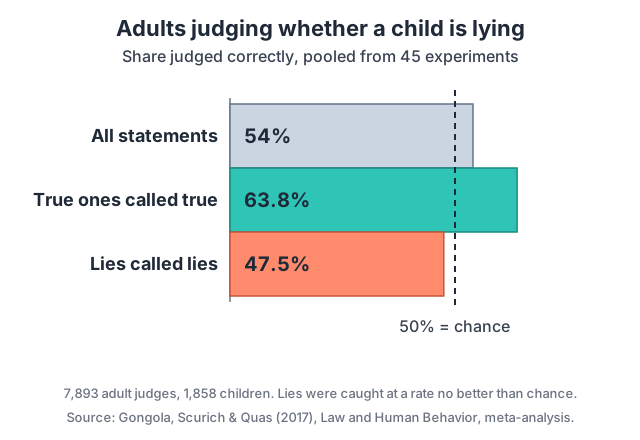
Almost all of those studies used other people's children, and you know your own better than a stranger does. But the practical lesson holds. If your plan for dealing with lies depends on catching them, it is built on a skill nobody seems to have.
The Myth: That a Harsher Response Makes Kids More Honest
The instinct is understandable. Lying feels like a second offence piled on top of the first, so it seems obvious that it should cost more. Many parents say some version of "you will be in far more trouble for lying than for what you did." The research suggests that harsher responses often produce more lying, and better lying, rather than less.
A punishing environment produced more and better lies
The clearest evidence comes from a natural experiment in West Africa. Victoria Talwar and Kang Lee compared 3- and 4-year-olds at two private schools in the same city that served similar families. The difference was discipline. In one school, teachers routinely used corporal punishment, slapping, pinching and hitting with a stick. Researchers watching the classrooms of the 3- and 4-year-olds over four days counted around 15 physical punishments a day, often for things as small as forgetting a pencil. The other school did not use physical punishment.[9]
Children at the two schools were about equally likely to peek at the toy. What differed was what came next. Among the children who peeked, 94% at the punitive school lied about it, compared with 56% at the other school. The children from the punitive school were also much better liars. Most of them kept their story straight under follow-up questioning, something researchers usually only see in children over six.[9]
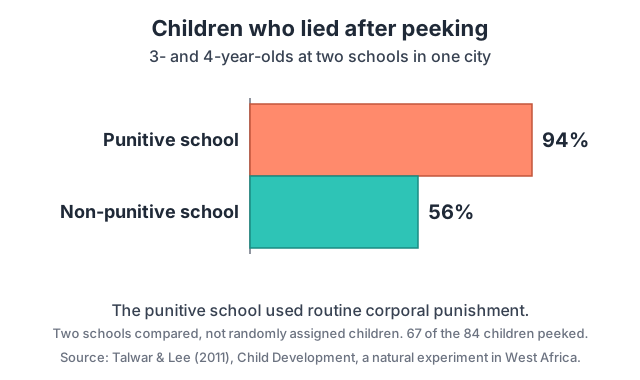
That study has real limits. It compared two schools, not randomly assigned children, and the punishment it described was severe and physical, far beyond what most parents mean by a consequence. But the direction is hard to miss. In an environment where telling the truth reliably brings pain, children learn to lie early, and they learn to lie well.
Expecting punishment undercut an appeal to the child's own standards
A larger experiment looked at milder conditions. Talwar and colleagues tested 372 children aged 4 to 8, again looking at whether children would admit to breaking a rule. Before asking, the researcher said one of several things. Some children heard nothing special. Some heard that the researcher would be happy if they told the truth. Some heard that they would feel good about themselves if they told the truth. And some of those children were also led to expect punishment.[10]
Telling children that the adult would be happy to hear the truth made them significantly more honest than saying nothing. The appeal to children's own sense of feeling good about themselves depended on punishment: children who heard it and also expected punishment were significantly more likely to lie than children who heard it with no threat.[10] The threat of punishment undercut the appeal to the child's own standards.
Scary stories about lying do not work either
Most of us grew up on Pinocchio and the Boy Who Cried Wolf, stories built around what happens to liars. In one experiment with 3- to 7-year-olds, neither story made children any more honest. The story that did was George Washington and the cherry tree, where the boy confesses and his father praises him for telling the truth. When the researchers rewrote the Washington story so it dwelt on the bad consequences of lying instead, it stopped working too.[11]
The pattern across these studies is consistent. Children respond to what the truth earns them, and much less to warnings about what a lie will cost.
The Boring Fundamentals: What Makes Honesty More Likely
The unglamorous finding underneath all of this is that a child's honesty depends a great deal on how safe it is to be honest. That sounds soft. It is actually quite a concrete thing you can change.
Children confess more when they expect a good reaction
In a study of 48 children aged 4 to 9, researchers asked children how they thought a parent would react if a child confessed to something they had done wrong. Older children expected parents to react better to a confession than younger children did. And the children who expected a more positive reaction from a parent were, according to their own parents, the ones who confessed more often in real life.[12] That was a small study and a correlation, so it cannot tell us which way the influence runs. But it fits everything above. The children who tell the truth are the ones who believe the truth will be received well.
Asking for a promise helps
In courtrooms, child witnesses are often asked to talk about the difference between truth and lies, and then to promise to tell the truth. Evans and Lee tested both steps in two experiments with young people aged 8 to 16, who had a chance to peek at the answers to a test and then were asked whether they had. In the first, about half peeked, and most of those lied. When those who had lied were asked to promise to tell the truth, they were about eight times more likely to switch to the truth than young people in the second experiment, who talked through the difference between truth and lies instead. That talk did not have the same effect.[13] The promise did not make everyone honest: 38 of the 49 who had lied were still lying after it. It was also a lab test with a stranger, not a kitchen with a parent. But the contrast is useful. Asking for a promise did more than a conversation about truth and lies.
The lies we tell them count
Here is the part that is uncomfortable for nearly all of us. Researchers call it "parenting by lying," and it is extremely common. A review by Peipei Setoh and colleagues describes parents lying to children to influence their behavior or their feelings, including false threats and false promises told to get a child to comply.[14] "If you don't come now, I'm leaving without you" is the version most of us know. In one survey, 84% of American parents and 98% of Chinese parents said they had lied to their children to get them to behave, and the most common lie was a false threat to leave the child alone in public.[15] The review also reports that parents who said they were strongly committed to teaching their children that lying is wrong were just as likely as other parents to do it.[14]
Does it matter? Several studies suggest it is linked to children's own lying. In a survey of 379 young adults in Singapore, those who remembered more parenting by lying in childhood reported lying more to their parents as adults, and also reported more psychological difficulties.[16] In a study of 564 Singaporean families with 11- and 12-year-olds, children who reported more exposure to lies told to make them comply lied to their parents more.[17] Both studies are correlations, and the review authors are clear that parenting by lying could stand in for other things about a family, so these findings cannot show that the parents' lies caused the children's.[14]
There is one experiment, though. Chelsea Hays and Leslie Carver had a researcher lie to half the children in their study before running the "do not peek" test. School-age children who had just been lied to were more likely to peek, and more likely to lie about it. Preschoolers showed no difference.[18] A single lie from a stranger was enough to shift older children's behavior. Whether a parent's lies work the same way over years is not yet known, but it is a reason to notice them.
With teenagers, what you know depends on what they tell you
As kids get older, the question shifts from "did you take the cookie" to "where were you," and many parents respond by tracking more closely. A well-known Swedish study of 703 fourteen-year-olds and their parents asked where parents' knowledge of their teenagers' lives actually came from. The answer was mostly from the teenagers themselves, telling them freely. The teenager's own disclosure was also the source of parental knowledge most closely linked to lower delinquency.[19]
That does not make checking pointless. A later study of rural early adolescents found that parents' efforts to keep track and young people's own disclosure in the fall of sixth grade both predicted lower substance use and delinquency in eighth grade, partly by way of how much the mother knew. Parents' efforts to keep track translated into knowledge more strongly in families with warmer relationships.[20] So asking and keeping track still matter, and they work better in a warm relationship.
How parents react to what they hear matters for whether they keep hearing it. Following 982 young people across three waves, researchers found that negative reactions from parents when a teen disclosed something predicted teens feeling more controlled and less connected, which in turn predicted more secrecy and less disclosure later. Positive reactions predicted feeling more connected and more disclosure.[21] In a study of 276 American high school students, greater trust in parents predicted more disclosure and less secrecy.[22]
In other words, a teenager who tells you something hard and gets yelled at has learned something specific about the price of telling you things. The research suggests they will act on that lesson.
When the Standard Advice Doesn't Fit
The child who lies to avoid fear, not to get away with something
Some children lie less to escape a consequence than to escape a feeling: the fear of being in trouble, of disappointing you, of the moment itself. I wrote before about how anxiety can come out looking like defiance and about what happens when we protect an anxious child from every fear. I think the same logic applies here. The research above found that expecting punishment undercut an appeal to the child's own sense of doing right,[10] and for an anxious child, a stern face may feel like a threat whether or not you intend one. For that child, lowering the temperature of the conversation before you ask may matter more than anything you say.
The child who lies because politeness asked them to
If your child tells Grandma they love a present they plainly do not, they are doing what most children in that study did, and a quick word from a parent made it even more likely.[7] I think it helps to treat these as a separate category from lies that cover a misdeed, and to talk about them separately when your child is old enough. "We tell Grandma thank you because she tried hard to get you something nice" is a different conversation from "you told me you finished your homework."
Children moving between two households
When children live across two homes, the question "what happened at your mom's?" or "what happened at your dad's?" can put them in a hard spot. I believe a lot of what looks like lying in that situation is a child trying not to be caught between two people they love. The research on what predicts how kids do after a divorce is consistent that feeling caught in the middle is one of the things that harms children most. If your child goes vague or contradicts themselves about the other house, I would treat it first as a sign that the question itself is uncomfortable, not as a character problem to fix.
I have seen another side of this in my own family. Most of the untrue things my kids have said to me were not lies they made up. They were things they had heard somewhere else and repeated, like "your daddy is a bad person" or "your dad didn't take care of you when you were a baby." Those things are not true, and my kids did not invent them. Children soak up what the adults around them say and repeat it, whether it is true or not. That is part of why lies do so much harm: a lie told to a child does not stay with the child. I am fortunate that my kids trust me enough to come and ask me whether something they heard is true. Even so, I have lost whole days to these lies.
My Own Reckoning
Telling the truth is too important to me to make exceptions for the convenient lies. I want my kids to always be able to trust my word, and I would rather not tell a lie and have it come back on me later. I strongly believe lies hurt people. I also believe that if my kids think small lies are okay, big lies become easier to tell, and I don't want a big lie to be what ends up hurting them. So I would rather tell them the truth and teach them the integrity behind it.
When one of my kids does lie to me, I try to approach it with curiosity and kindness. In my experience, most of their lies come from one of three places: something they learned from someone else in their life, a lie they were told themselves, or fear. When I come at it with kindness and love, they tend to calm down, open up and tell me the truth. That is how I try to approach most of my life.
What To Do Instead
Each of these ties back to a finding above. None of them requires you to catch the lie first, which is good, because the evidence says you probably cannot.[8]
- Don't ask questions you already know the answer to. "Did you eat the cookies?" when there are crumbs on their shirt is the "do not peek" experiment in your kitchen. It hands the child a choice between confessing and lying, and a majority of children pick the lie.[2] When you already know, say what you know: "I see the cookies are gone. Let's talk about that." There is no lie to tell. This one is my own reasoning from the way the experiments work, but it follows directly from them.
- Make the truth cheaper than the lie. If telling you the truth reliably leads to an explosion, the research suggests you will hear less truth.[9][10] That does not mean no consequences. It means the consequence for what they did should not grow because they admitted it, and that admitting it should earn something real, even if it is only your calm.
- Tell them what the truth earns. Children in the experiments were more honest when the adult said they would be happy to hear the truth,[10] and when the story they heard showed honesty being praised.[11] "I'm going to be glad you told me, even if it's something I don't like" is a sentence worth practicing out loud.
- When you need the truth, ask for a promise. In one study, asking young people to promise to tell the truth did more than talking through the difference between truth and lies.[13]
- React to the confession before you react to the deed. When your child does tell you something hard, the first thing they learn is how you received it. Thank them for telling you. Then deal with the thing. Children who expect a good reaction to confessing confess more,[12] and teenagers whose parents react badly tell them less over time.[21]
- Notice your own convenient lies. The threat you will not carry out, the store that "is closed," the shot that "won't hurt at all." Most parents in the surveys say they tell them.[14] You do not have to become perfectly honest to make a difference. You might start by swapping the false threat for a true one you are willing to carry out.
- With teenagers, keep the line open rather than tightening the net. What you know about your teenager's life comes mostly from what they choose to tell you.[19] Checking in still matters, and it works best in a warm relationship.[20] The thing to protect is their willingness to tell you things, because that is the source of almost everything else.
- With little ones, respond to the act, not the character. A three-year-old's first lies tend to go along with growing self-control and a growing understanding of other minds.[1][4] "You're a liar" puts a label on a child who is just learning what minds are. "I think that's not what happened. Let's try again" leaves room for the truth.
It Is Not Too Late to Change the Price of the Truth
If you have been strict about lying, or if you recognize your own family in the punitive school study, it is worth knowing how quickly children in these experiments responded to a change in the situation in front of them. A single sentence from an adult ("I'll be happy if you tell me the truth") shifted how honest children were in one session.[10] A single lie from an adult shifted older children's behavior the other way in the same session.[18] That cuts both ways, and it is the hopeful part. Children's honesty is responsive to what is happening around them now, not fixed by what happened before.
The longer-term research on teenagers points in the same direction. In the three-wave study, parents' reactions came first: how parents responded to what teens told them predicted how much those teens told them later.[21] A parent who starts reacting differently is starting a different cycle.
When to Get Help
Most lying is ordinary. But a few patterns are worth talking to your child's doctor, a school counselor or a child psychologist about.
- Lying that is frequent, persistent and comes with other problems. In a Canadian study that followed 1,128 children whose mothers and teachers rated them at ages 6, 7 and 8, lying was common at those ages. The children rated as frequent liars by both adults across all three years were also rated as more disruptive by teachers, both at the time and when the children were 10 and 11.[23] Among young teenagers, more frequent lying has been linked to behavior and emotional problems and to strain in the parent-child relationship.[24] Lying on its own is rarely the issue. Lying alongside fighting, stealing, destroying things, or a child who seems to feel no concern at all when caught, is worth a professional's view.
- Lying that hides fear, low mood or self-harm. If you suspect a child is hiding that they are struggling, the lie is the smaller problem. Ask gently, and get help.
- Secrets an adult has asked a child to keep. A child who is lying or going quiet about time with a particular adult, or who says someone told them to keep a secret, needs a calm, careful conversation and possibly outside help. The Childhelp National Child Abuse Hotline answers at 1-800-422-4453 (call, or text "GO" to the same number), for parents who are worried as well as for children.
- Lying in a teenager that covers serious risk, such as drugs, unsafe relationships or being somewhere dangerous. The goal is still to keep them talking to you, and a family therapist can help you do that while dealing with the risk.
If You're Reading This
If you are the parent of a toddler or preschooler who just told their first lie: this is a normal developmental step, and in these studies lying became common between the ages of two and three. Respond calmly, give them a way back to the truth, and do not treat it as a character flaw.
If you are the parent who has been coming down hard on lying: you were trying to raise an honest kid, and that is a good goal. The research suggests a different route to it. Lowering the cost of the truth is not going soft. It is the thing that, in these studies, actually produced more truth.
If you are the parent of a teenager who has stopped telling you things: the door is not closed. Pay attention to how you react the next time they tell you anything at all, even something small. That is the part of the cycle you control.
If you are co-parenting across two homes: be careful with questions about the other house. A child going vague may be protecting both of you.
The Bottom Line
Most children lie at least some of the time, starting around age two or three, and early lying goes along with normal growth in how children understand other minds. You probably cannot tell when your child is lying, and you do not need to. What the research suggests is that children tell the truth more when the truth is safe, when honesty earns something, and when the adults around them are honest too. Harsh punishment, scary stories and lectures mostly do not help, and the evidence on punishment points toward more and better lies. The most useful question is not "how do I catch them?" It is "what does telling me the truth cost in my house?"
Resources & Further Reading
- Childhelp National Child Abuse Hotline (childhelphotline.org). Call 1-800-422-4453, or text "GO" to the same number, for children and for adults worried about a child.
- Related reading on this site: The Invisible Echo, on what the research says about yelling, which is often the reaction a lie gets. Why Your "Defiant" Kid Might Actually Be Anxious and The Accommodation Trap, on children whose behavior is driven by fear. What Actually Predicts How Kids Do After a Divorce, on keeping children out of the middle between two homes.
References
↑ [1]: Evans, A. D., & Lee, K. (2013). "Emergence of lying in very young children." Developmental Psychology, 49(10), 1958-1963. PMID 23294150. Available at: https://doi.org/10.1037/a0031409
↑ [2]: Talwar, V., & Lee, K. (2008). "Social and cognitive correlates of children's lying behavior." Child Development, 79(4), 866-881. PMID 18717895. Available at: https://doi.org/10.1111/j.1467-8624.2008.01164.x
↑ [3]: Debey, E., De Schryver, M., Logan, G. D., Suchotzki, K., & Verschuere, B. (2015). "From junior to senior Pinocchio: A cross-sectional lifespan investigation of deception." Acta Psychologica, 160, 58-68. PMID 26182909. Available at: https://doi.org/10.1016/j.actpsy.2015.06.007
↑ [4]: Lee, J. Y. S., & Imuta, K. (2021). "Lying and Theory of Mind: A Meta-Analysis." Child Development, 92(2), 536-553. PMID 33462865. Available at: https://doi.org/10.1111/cdev.13535
↑ [5]: Sai, L., Shang, S., Tay, C., Liu, X., Sheng, T., Fu, G., Ding, X. P., & Lee, K. (2021). "Theory of mind, executive function, and lying in children: a meta-analysis." Developmental Science, 24(5), e13096. PMID 33544950. Available at: https://doi.org/10.1111/desc.13096
↑ [6]: Ding, X. P., Wellman, H. M., Wang, Y., Fu, G., & Lee, K. (2015). "Theory-of-Mind Training Causes Honest Young Children to Lie." Psychological Science, 26(11), 1812-1821. PMID 26431737. Available at: https://doi.org/10.1177/0956797615604628
↑ [7]: Talwar, V., Murphy, S. M., & Lee, K. (2007). "White lie-telling in children for politeness purposes." International Journal of Behavioral Development, 31(1), 1-11. PMID 18997880. Available at: https://doi.org/10.1177/0165025406073530
↑ [8]: Gongola, J., Scurich, N., & Quas, J. A. (2017). "Detecting deception in children: A meta-analysis." Law and Human Behavior, 41(1), 44-54. PMID 27685642. Available at: https://doi.org/10.1037/lhb0000211
↑ [9]: Talwar, V., & Lee, K. (2011). "A punitive environment fosters children's dishonesty: a natural experiment." Child Development, 82(6), 1751-1758. PMID 22023095. Available at: https://doi.org/10.1111/j.1467-8624.2011.01663.x
↑ [10]: Talwar, V., Arruda, C., & Yachison, S. (2015). "The effects of punishment and appeals for honesty on children's truth-telling behavior." Journal of Experimental Child Psychology, 130, 209-217. PMID 25447716. Available at: https://doi.org/10.1016/j.jecp.2014.09.011
↑ [11]: Lee, K., Talwar, V., McCarthy, A., Ross, I., Evans, A., & Arruda, C. (2014). "Can classic moral stories promote honesty in children?" Psychological Science, 25(8), 1630-1636. PMID 24928424. Available at: https://doi.org/10.1177/0956797614536401
↑ [12]: Smith, C. E., & Rizzo, M. T. (2017). "Children's confession- and lying-related emotion expectancies: Developmental differences and connections to parent-reported confession behavior." Journal of Experimental Child Psychology, 156, 113-128. PMID 28063404. Available at: https://doi.org/10.1016/j.jecp.2016.12.002
↑ [13]: Evans, A. D., & Lee, K. (2010). "Promising to tell the truth makes 8- to 16-year-olds more honest." Behavioral Sciences & the Law, 28(6), 801-811. PMID 20878877. Available at: https://doi.org/10.1002/bsl.960
↑ [14]: Setoh, P., Low, P. H. X., Heyman, G. D., & Lee, K. (2024). "Parenting by Lying." Current Directions in Psychological Science, 33(1), 51-57. PMID 38343870. Available at: https://doi.org/10.1177/09637214231206095
↑ [15]: Heyman, G. D., Hsu, A. S., Fu, G., & Lee, K. (2013). "Instrumental lying by parents in the US and China." International Journal of Psychology, 48(6), 1176-1184. PMID 23173801. Available at: https://doi.org/10.1080/00207594.2012.746463
↑ [16]: Setoh, P., Zhao, S., Santos, R., Heyman, G. D., & Lee, K. (2020). "Parenting by lying in childhood is associated with negative developmental outcomes in adulthood." Journal of Experimental Child Psychology, 189, 104680. PMID 31500808. Available at: https://doi.org/10.1016/j.jecp.2019.104680
↑ [17]: Low, P. H. X., Kyeong, Y., & Setoh, P. (2024). "Parenting by lying and children's lying to parents: The moderating role of children's beliefs." Journal of Experimental Child Psychology, 240, 105837. PMID 38183877. Available at: https://doi.org/10.1016/j.jecp.2023.105837
↑ [18]: Hays, C., & Carver, L. J. (2014). "Follow the liar: the effects of adult lies on children's honesty." Developmental Science, 17(6), 977-983. PMID 24636361. Available at: https://doi.org/10.1111/desc.12171
↑ [19]: Stattin, H., & Kerr, M. (2000). "Parental monitoring: a reinterpretation." Child Development, 71(4), 1072-1085. PMID 11016567. Available at: https://doi.org/10.1111/1467-8624.00210
↑ [20]: Lippold, M. A., Greenberg, M. T., Graham, J. W., & Feinberg, M. E. (2014). "Unpacking the Effect of Parental Monitoring on Early Adolescent Problem Behavior: Mediation by Parental Knowledge and Moderation by Parent-Youth Warmth." Journal of Family Issues, 35(13), 1800-1823. PMID 25382891. Available at: https://doi.org/10.1177/0192513X13484120
↑ [21]: Tilton-Weaver, L., Kerr, M., Pakalniskeine, V., Tokic, A., Salihovic, S., & Stattin, H. (2010). "Open up or close down: how do parental reactions affect youth information management?" Journal of Adolescence, 33(2), 333-346. PMID 19716171. Available at: https://doi.org/10.1016/j.adolescence.2009.07.011
↑ [22]: Smetana, J. G., Metzger, A., Gettman, D. C., & Campione-Barr, N. (2006). "Disclosure and secrecy in adolescent-parent relationships." Child Development, 77(1), 201-217. PMID 16460534. Available at: https://doi.org/10.1111/j.1467-8624.2006.00865.x
↑ [23]: Gervais, J., Tremblay, R. E., Desmarais-Gervais, L., & Vitaro, F. (2000). "Children's persistent lying, gender differences, and disruptive behaviours: A longitudinal perspective." International Journal of Behavioral Development, 24(2), 213-221. Available at: https://doi.org/10.1080/016502500383340
↑ [24]: Engels, R. C. M. E., Finkenauer, C., & van Kooten, D. C. (2006). "Lying behavior, family functioning and adjustment in early adolescence." Journal of Youth and Adolescence, 35(6), 949-958. Available at: https://doi.org/10.1007/s10964-006-9082-1
Tags
Written by
Steadykeep
Published
October 1, 2026