Should You Still Read Aloud to a Kid Who Can Read? What the Research Says After Age 8
Most families stop reading aloud once a child can read alone. The research on listening, vocabulary and older readers suggests it still has a job to do after that.
My oldest can read perfectly well on her own, and I still read to her. Lately she has loved a Halloween book about a werewolf who wants to go dancing, but his friends are scared to dance with him because of something about him. He asks almost all of his friends until he comes across a Frankenstein monster who wants to dance, and then he judges the monster for who they are and refuses. After he walks away, he realizes what he did, runs back, and starts dancing with him. Then all of their friends apologize and want to join in.
It has a sweet message about not judging others, and it is one that might go over my daughter's head if we could not talk about it. Reading books like this, the kind that lead to important conversations, matters for the relationship between a parent and a child.
Why I Started Looking at the Research
There is a moment most parents remember, when a kid who used to bring you the book starts reading it to themselves. It feels like a finish line. The thing you were working toward happened, and the nightly read-aloud slides off the list without anyone deciding it should.
That is the pattern in the numbers too. A national US survey run for the children's publisher Scholastic found that reading aloud at home peaks at about age five and then falls with each year of age, with the first big drop among six- to eight-year-olds, the years when many kids become independent readers. When parents were asked why they read aloud less or stopped, the most common answer was that their child can read on their own.[1]
So the question I wanted answered was a narrow one. Once a kid can read the words, is there still a reason to read to them? Or is it a sweet habit that has done its job?
What I found is that "can read the words" and "can understand everything a book has to offer" are two different skills, and they keep developing on different schedules for years after a child can decode. Once the words come easily, what limits how much a kid gets from a book is mostly how well they understand language, and being read to draws on exactly that. That is the reason the read-aloud has not finished its job at eight. It is also why the books worth reading aloud at ten are harder than the ones they would pick up alone.
What Is Actually Happening When a Kid "Can Read"
Reading researchers have a model for this that is simple enough to hold in your head. It is called the simple view of reading, and it says that understanding what you read takes two things: turning the print into words (decoding), and understanding the language once you have it (which researchers measure as listening comprehension, how well a child understands the same passage read aloud to them).[2]
Early on, decoding is the bottleneck. A six-year-old sounding out each word has very little attention left for what the sentence means. As decoding gets fast and automatic, the bottleneck moves. A review by Hogan and colleagues brought together the evidence that listening comprehension becomes the dominating influence on reading comprehension starting even in the elementary grades.[2] Put plainly, once a child can read the words, what limits their understanding of a book is mostly how well they understand language, and that is the skill a child uses when they are read to.
A large Finnish study shows the shift happening early. It followed 1,815 children from kindergarten to third grade. The direct effect of reading fluency on reading comprehension disappeared after first grade, while the effect of listening comprehension stayed significant every year.[3] Finnish is spelled very regularly (the paper calls it a transparent orthography), so the hand-off may come at a different point in English. The direction matches what Hogan's review describes for English-speaking children.
Two skills that take years to meet
The two skills also do not line up straight away. A study of 612 students in grades 2, 4, 6 and 8 had each child both read and listen to stories and informational passages, then checked what they had understood.[4] Listening and reading comprehension became more closely linked once children had mastered decoding, and the difference between them shrank as children moved up the grades. By eighth grade, students understood more of what they read than of what they heard, for both kinds of text. Hogan's review describes a separate long-term study in which, by eighth grade, listening and reading comprehension had merged into what was statistically a single skill.[2]
That is the window. In the years between decoding and that merger, a child's understanding of language is doing more and more of the work in their reading, and being read to puts exactly that skill to work. Reading aloud during those years is not doing the reading for them. It is giving them the book their understanding is ready for, while their own reading catches up with it.
Book language is not conversation
The second thing happening is about the words themselves. The language in books is richer than the language we speak to children.
Montag and colleagues built a collection of 100 children's picture books and compared it with a matched sample of speech adults directed at children.[5] The picture books contained more unique words than the speech, and individual books generally contained more unique words than conversations of the same length. That study was about picture books for young children. The next one looks at what happens as children get older.
A 2025 study looked at the move into middle childhood. Researchers built three child-directed collections of 1.6 million words each in Chinese, one each for speech, print and media, and checked them against the ages at which children learn 361 words.[6] Print was the most varied of the three and everyday speech the least. Speech variety best predicted word learning before middle childhood; in an exploratory analysis, the variety in other sources, print among them, became the stronger predictor after that. In both phases, words that turned up in more varied contexts tended to be learned earlier.
A chapter book read aloud is book language arriving through the ear, pitched at the child's understanding rather than their decoding. That is a different diet from either everyday talk or the books they can manage alone.
Seeing the page while hearing it
One small experiment is worth knowing about because it tells you something you can do tonight. Alessandra Valentini and colleagues gave 71 eight- and nine-year-olds a story containing made-up words, in one of three ways: they listened to it, read it themselves, or listened while following the printed text.[7] Children learned the most about what the new words meant when they heard the story and saw the words at the same time, more than with listening alone or reading alone. Only the children who saw the printed words learned how they were spelled.
So when a kid wants to sit close and look at the page while you read, that is not a distraction from the read-aloud. In this study it was the best version of it for learning what new words mean.
The Myth: Reading Aloud Is Training Wheels
The usual framing treats reading aloud as a phase on the way to independent reading. You read to them until they can do it, and then you stop, the way you take the training wheels off a bike.
The research does not support stopping on that basis, for two reasons.
The first is the one above. Decoding and understanding develop on different schedules, and the read-aloud feeds the one that is still developing. Taking it away when decoding is done removes the support from the skill that is just becoming the limiting one.
The second is about what happens to reading itself after age eight or nine. The same Scholastic survey, in its 2023 edition, found a steep drop in how much kids enjoy reading as they get older: 70% of six- to eight-year-olds said they enjoy reading books for fun, against 46% of twelve- to seventeen-year-olds. Frequent reading, five to seven days a week, showed the same slide: 46% of six- to eight-year-olds, against 15% of fifteen- to seventeen-year-olds.[8] That survey cannot tell you why enjoyment falls. It does show that the years when families stop reading aloud are the same years when reading starts to slip out of kids' lives.
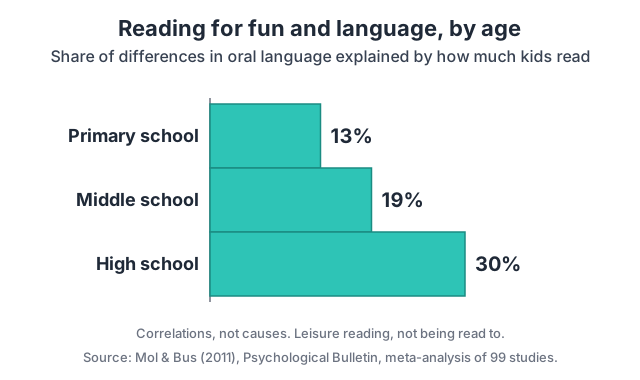
That matters because how much children read stays linked to how well they read, and the link with their language skills gets stronger with age. A meta-analysis of 99 studies by Mol and Bus looked at leisure-time reading from preschool to university.[9] Print exposure was moderately to strongly linked with reading comprehension and spelling, and its link with oral language grew with age: it explained 13% of the differences in oral language skills in primary school, 19% in middle school and 30% in high school. The authors read this as an upward spiral: children who read well read more, and reading more makes them better readers each year. They also found that poor readers appeared to benefit from leisure reading, and they suggested that shared book reading with young children may be part of one continuum of out-of-school reading that runs all the way through development.
A British cohort study points the same way from a different angle. It followed 3,583 people born in 1970 and found that reading for pleasure in childhood was linked to substantial progress in vocabulary between ages 10 and 16, and more weakly to progress in math. Reading for pleasure was more strongly linked to that progress than parents' education was.[10] That study measured the children's own reading, not being read to, and it is a correlation, not a trial. What it adds is that the habit at ten seems to count for something at sixteen.
Put together, the read-aloud is less like training wheels and more like one of the ways a family keeps reading in a kid's life while their own reading is still finding its feet.
What older kids say about it
When researchers ask the children instead of the parents, the answer is fairly consistent. In the 2019 Scholastic survey, 83% of children aged six to fourteen who were or had been read aloud to said they loved it or liked it a lot, and 85% said it was a special time with their parent.[1]
An Australian study by Susan Ledger and Margaret Merga asked 220 children aged six to twelve in Western Australia about being read to at home and at school.[11] The authors concluded that their findings support reading aloud continuing past the point when children can read independently, and they raised concern about how rarely it happened at home and at school. A related paper by Merga and Saiyidi Mat Roni, drawing on older students' own accounts, made a point that will sound familiar to a lot of parents: once children can read on their own, parents may become a less powerful source of encouragement, even though they can still play an important role in keeping reading going.[12]
None of this means every ten-year-old wants a bedtime story. Some will roll their eyes at the offer, and that is their call. But in these surveys, "they can read now" is the reason parents give for stopping, and most of the children who were read to say they loved it or liked it a lot.
The Most Direct Evidence Comes From Classrooms of 12- and 13-Year-Olds
The most direct test I found of reading aloud to kids who can already read was done with twelve- and thirteen-year-olds.
Jo Westbrook and colleagues worked with 20 English teachers in the South of England who changed how they taught novels to their average and weaker readers.[13] Instead of working slowly through short extracts with a lot of stopping to analyze, each class read two whole, challenging novels in 12 weeks, at a faster pace than usual. The general pattern was for the whole text to be read aloud in class, often by the teacher. Half the teachers also had extra training in teaching comprehension.
Students in both groups made an average of 8.5 months' progress on standardized reading comprehension tests in those 12 weeks. The weaker readers, students a year or more behind their age in reading, made an average of 16 months' progress. The extra training made no measurable difference to the scores.
Two details from the full paper matter for parents. The approach that seemed to work was a confident reader reading a good book aloud, steadily, and stopping only when the students looked lost. The classes where students took turns reading paragraphs aloud to the room went worse: fear of mispronouncing words slowed students down, and the weaker readers found it hard to follow. And the weaker readers, despite their big gains, were still well behind at the end. Twelve weeks of good reading aloud went with big gains. It did not erase years of difficulty.
This was a classroom study, not a trial at home, and every class in it tried the new approach, so there was no group of students who kept the old one for comparison. It is still the clearest picture I found of what happens when kids who can read are read to anyway, with books harder than they would choose alone.
The Boring Fundamentals
What the evidence points to is not a technique. It is mostly a few plain habits.
Read above their level. The whole case for reading aloud to an independent reader rests on the gap between what they can understand by listening and what they can decode. A book they could read easily on their own wastes that gap. A book a little beyond them uses it. The Westbrook classes read complex novels that, the authors found, challenged their teachers' assumptions about what the students could handle.[13]
Keep it moving. Stopping every page to quiz them turns a story into a test. In the Westbrook classrooms, the teachers who read longer stretches and paused only at real confusion kept students engaged, and the one who stopped after every page to ask prepared questions had a group of poor readers asking to just read.[13] Ask a question when they look lost, or when you genuinely want to know what they think.
Let them see the page when they want to. Listening while following the text was the best condition for learning new word meanings in the Valentini study.[7] Sitting side by side does this without any fuss.
Talk about it, a little. The 2019 Scholastic survey found that children aged six to eleven who asked questions or made funny noises during read-aloud time were more likely to be frequent readers. The report itself says the link is not clearly causal.[1] I read it as a description of what a good read-aloud looks like, a back-and-forth, rather than a technique to add.
It does not have to be bedtime. If evenings are a scramble, a chapter at breakfast, in the car or on a weekend morning is the same book. If bedtime is part of the fight, there is more on why in Why Your Kid Isn't Sleeping.
When the Standard Advice Doesn't Fit
Kids who struggle to decode
For a child whose decoding is slow or effortful, being read to is not a lesser version of reading. It may be the main way they can get at books their age group is reading. The International Dyslexia Association notes that students with dyslexia can benefit from listening to audiobooks and from text-reading software, alongside the structured teaching they need for decoding itself.[14]
There is a small study that points the same way. In Italy, 20 adolescents with dyslexia used audiobooks, for school books and for other books, over five months, and were compared with 20 who kept using ordinary books.[15] The audiobook group improved in reading accuracy, showed less unease and fewer emotional and behavioral difficulties, and did better at school with more motivation. Forty students is a small sample, so hold that loosely, but nothing in it suggests listening gets in the way of learning to read.
What reading aloud does not do is replace help with decoding. If a child is struggling to turn print into words, they need that taught directly, and the section below on when to get help covers how.
Kids whose listening is the weaker skill
The reverse also happens. Hogan's review describes children known as poor comprehenders, who have real trouble understanding what they read despite adequate word reading, mainly because their listening comprehension is weak.[2] Because they read the words well, many are not identified until the later primary grades. Reading aloud together is one of the everyday moments where a parent might notice, because you can talk about what you both just heard.
Kids who say no
Some older kids do not want to be read to, and pushing turns a pleasure into a chore. In my view the offer matters more than the yes. Audiobooks in the car, a book you both read separately and talk about, or reading the first chapter of something and leaving it on the table all keep the door open without a negotiation.
Two households
If your kid splits time between two homes, a long read-aloud book can feel impossible to keep going. A book that travels in a backpack, or a separate book that lives at your house and only gets read on your nights, both work. A series where each book stands alone is forgiving of a week's gap. This is not something the research has tested. It is the same idea as the rest of this post, applied to a calendar that does not cooperate. There is more on activities across two homes in Can My Kid Do Activities If I Only Have Them Every Other Week?
Reading Aloud in My House
If my kids want me to read them a book, I do my best to read it to them, at least the first time. Sometimes I will ask my oldest to try reading it herself, so she can practice.
I also think it is important for anyone to be able to talk about what they read, and my kids are no exception.
What To Do Instead
- Do not stop because they can read. That is the most common reason parents give.[1] Once the words come easily, their understanding of language is what limits their reading,[2] and that is the skill a read-aloud puts to work.
- Choose books a step above what they would read alone. The classroom study used novels that several of its teachers first thought too hard for these students.[13]
- Read in long, steady stretches. Stop when they look lost or when something is worth talking about, not to check comprehension every page.[13]
- Let them follow along on the page. It was the best condition for learning new words in the Valentini study.[7]
- Do not make it a performance. If they want to read a page to you, great. In the classroom study, round-robin reading, with students called on in turn to read a paragraph to the class, slowed things down and left the weaker readers struggling to follow.[13]
- Count audiobooks. For a child who finds decoding hard, they are a real way into books, and they work in the car.[14]
- Keep your own reading visible. In the 2023 Scholastic survey, parents were the reading role models children named most often (83%), and frequent readers were far more likely than infrequent readers to say a lot of the people in their lives enjoy reading.[8] That is a correlation, but it costs nothing to act on.
- Let it change shape as they grow. Taking turns with chapters, reading the same book separately and talking about it, or a shared audiobook on a drive are all reading together.
The Good News
If the read-aloud stopped in your house a while ago, nothing here says the window has closed. In the long-term study Hogan's review describes, listening comprehension's share of reading comprehension was still growing between fourth and eighth grade,[2] and the clearest result I found came from twelve- and thirteen-year-olds.[13] The weaker readers in that study gained the most.
And the case for picking it back up does not rest on test scores. The children in those surveys mostly remember being read to as a special time with a parent.[1] Very few things you can do on a weeknight with a book and twenty minutes have that going for them.
When to Get Help
Reading aloud is not a treatment for a reading difficulty. Talk to your child's teacher, and ask about a formal evaluation, if you notice things like:
- Reading is still slow and effortful well after their classmates have become fluent, and slow enough that they lose the meaning.
- They have real trouble with letters and their sounds, or with spelling, beyond what the teacher expects for their age.
- They have real trouble sticking with, or understanding, longer reading assignments.
- They can read the words aloud correctly but often cannot tell you what happened in what they just read.
The International Dyslexia Association lists difficulties like the first three among the signs of dyslexia, while noting that not every child who has them has dyslexia, and that formal testing is the only way to confirm it.[14] In the US, parents have the right to request a comprehensive evaluation from the school at any point under the federal special education law (IDEA), whether or not the school is already providing extra reading help.[14] If the main difficulty is understanding language rather than decoding it, a speech-language evaluation is worth asking about too.[2]
If You're Reading This
If you stopped when they started reading on their own: you did what almost every parent does, for the reason almost every parent gives. Pick it back up with a book a little harder than they would choose. It is not too late.
If your kid reads all the time on their own: that is great, and keep it going. A read-aloud is not a correction. It is a chance to share a book they would not pick, and to talk about it.
If your kid struggles with reading: being read to is one of the ways they can keep up with what their friends are reading while they work on decoding. Get the decoding help too.
If your older kid says no: take the no. Leave the offer open, try an audiobook in the car, and keep reading where they can see you.
If you are short on time: ten minutes, three times a week, of a book they love is worth more than an hour that turns into a fight.
The Bottom Line
Being able to read the words is not the same as being able to understand everything a book offers. For years after kids can decode, what limits their reading is how well they understand language, and being read to draws on exactly that. The language in books is also richer than the language in conversation. Reading aloud to a kid who can read lets them use the understanding they have while their own reading catches up. Choose books a step above their level, read in long, easy stretches, let them follow along, and do not turn it into a test. Most kids who are read to say they love it or like it a lot. That alone is a good reason not to stop at eight.
Resources & Further Reading
- Scholastic Kids & Family Reading Report. The survey series quoted above, from a children's publisher. Useful for what families actually do, with the caveat that it is industry research, not peer-reviewed. https://www.scholastic.com/content/corp-home/kids-and-family-reading-report.html
- International Dyslexia Association, Dyslexia Basics. A plain explanation of dyslexia, its signs, and how evaluation works. https://dyslexiaida.org/dyslexia-basics/
- Your public library. Children's librarians are very good at the question "what is a great read-aloud for a kid who reads well but is not ready for this on their own", and most libraries lend audiobooks free through an app.
- Related posts on this site: Why Your Kid Isn't Sleeping and Can My Kid Do Activities If I Only Have Them Every Other Week?.
References
↑ [1]: Scholastic. (2019). Kids & Family Reading Report, 7th Edition: The Rise of Read-Aloud. National survey of 2,758 US parents and children, conducted by YouGov, fielded September-October 2018. Available at: https://www.scholastic.com/content/dam/scholastic/site/KFRR/KFRR_7th%20Edtidion.pdf
↑ [2]: Hogan, T. P., Adlof, S. M., & Alonzo, C. N. (2014). "On the importance of listening comprehension." International Journal of Speech-Language Pathology, 16(3), 199-207. PMID: 24833426. Available at: https://doi.org/10.3109/17549507.2014.904441
↑ [3]: Torppa, M., Georgiou, G. K., Lerkkanen, M.-K., Niemi, P., Poikkeus, A.-M., & Nurmi, J.-E. (2016). "Examining the simple view of reading in a transparent orthography: A longitudinal study from kindergarten to grade 3." Merrill-Palmer Quarterly, 62(2), 179-206. Available at: https://doi.org/10.13110/merrpalmquar1982.62.2.0179
↑ [4]: Diakidoy, I. N., Stylianou, P., Karefillidou, C., & Papageorgiou, P. (2005). "The relationship between listening and reading comprehension of different types of text at increasing grade levels." Reading Psychology, 26(1), 55-80. Available at: https://doi.org/10.1080/02702710590910584
↑ [5]: Montag, J. L., Jones, M. N., & Smith, L. B. (2015). "The words children hear: Picture books and the statistics for language learning." Psychological Science, 26(9), 1489-1496. PMID: 26243292. Available at: https://doi.org/10.1177/0956797615594361
↑ [6]: Li, L., Song, M., & Cai, Q. (2025). "The words children hear and see: Lexical diversity across-modalities and its impact on lexical development." Developmental Science, 28(2), e13601. PMID: 39740222. Available at: https://doi.org/10.1111/desc.13601
↑ [7]: Valentini, A., Ricketts, J., Pye, R. E., & Houston-Price, C. (2018). "Listening while reading promotes word learning from stories." Journal of Experimental Child Psychology, 167, 10-31. PMID: 29154028. Available at: https://doi.org/10.1016/j.jecp.2017.09.022
↑ [8]: Scholastic. (2023). "Reading in the Lives of Children and Parents." Kids & Family Reading Report, 8th Edition. National survey of 1,724 US parents and children, managed by Fluent Research, fielded December 2022 to January 2023. Available at: https://www.scholastic.com/content/corp-home/kids-and-family-reading-report/reading-lives.html
↑ [9]: Mol, S. E., & Bus, A. G. (2011). "To read or not to read: A meta-analysis of print exposure from infancy to early adulthood." Psychological Bulletin, 137(2), 267-296. PMID: 21219054. Available at: https://doi.org/10.1037/a0021890
↑ [10]: Sullivan, A., & Brown, M. (2015). "Reading for pleasure and progress in vocabulary and mathematics." British Educational Research Journal, 41(6), 971-991. Available at: https://doi.org/10.1002/berj.3180
↑ [11]: Ledger, S., & Merga, M. K. (2018). "Reading aloud: Children's attitudes toward being read to at home and at school." Australian Journal of Teacher Education, 43(3), 124-139. Available at: https://doi.org/10.14221/ajte.2018v43n3.8
↑ [12]: Merga, M. K., & Mat Roni, S. (2018). "Empowering parents to encourage children to read beyond the early years." The Reading Teacher, 72(2), 213-221. Available at: https://doi.org/10.1002/trtr.1703
↑ [13]: Westbrook, J., Sutherland, J., Oakhill, J., & Sullivan, S. (2019). "'Just reading': The impact of a faster pace of reading narratives on the comprehension of poorer adolescent readers in English classrooms." Literacy, 53(2), 60-68. Available at: https://doi.org/10.1111/lit.12141
↑ [14]: International Dyslexia Association. "Dyslexia Basics." Available at: https://dyslexiaida.org/dyslexia-basics/
↑ [15]: Milani, A., Lorusso, M. L., & Molteni, M. (2010). "The effects of audiobooks on the psychosocial adjustment of pre-adolescents and adolescents with dyslexia." Dyslexia, 16(1), 87-97. PMID: 19725019. Available at: https://doi.org/10.1002/dys.397
Tags
Written by
Steadykeep
Published
November 1, 2026