Why Your Kid Isn't Sleeping (And Why Almost Everything You've Been Told About It Is Asking the Wrong Question)
A dad's deep dive into the peer-reviewed research on children's sleep — what actually moves the needle, what the cry-it-out wars get wrong, and why most of the parenting-internet debates are asking the wrong question.
Why Your Kid Isn't Sleeping (And Why Almost Everything You've Been Told About It Is Asking the Wrong Question)
It's a Saturday night. Bath is done. Teeth are brushed. The story is read. The lights are low.
My 3-year-old is on the floor of the bedroom she shares with her sister, even though her own bed is three feet away. She has decided, with the kind of conviction only a 3-year-old can summon, that the floor next to where Dad is sitting is where she sleeps now. My 7-year-old, from her bed, has my left arm pinned under her head and is actively pulling it closer, like she's afraid I might float away in the night.
Both of them are talking. A lot. About the day. About a bug they saw. About whether dragons are real and, if so, whether one might live in our backyard. Neither of them is going to sleep on schedule. We all know this. We have known this for years now.
What they're really telling me, in the only way they know how, is that they missed me. That dad-time is precious enough that they are going to milk every minute of it before they let themselves fall asleep.
The parenting internet has a lot of opinions about this scene. About whether I should leave before they fall asleep, to teach independence. About whether the floor thing is creating a habit I'll regret. About whether sitting with them every night until they drift off is making them dependent on me. I have read those opinions. I have also, over the past several months, read a stack of peer-reviewed research on children's sleep that's tall enough to be its own bedtime hazard.
Here's what I learned: those two things, the parenting internet and the actual research, are not the same thing. They are not even in the same neighborhood.
The parenting internet wants you to pick a side in a method war. Cry it out or attachment parenting. Melatonin or "natural" sleep. Strict bedtime or responsive bedtime. The research, when you actually open it, keeps quietly suggesting that the method war is asking the wrong question. And that almost everything else you've been told to feel guilty about is asking the wrong question too.
This is a long piece, because the topic deserves it. But the thesis is short: most of the debates about kids and sleep are debates about how parents feel, not about what kids need. Once you see that pattern, you can't unsee it.
Why I Started Looking at the Research
When my kids are with me, bedtime is the part of the day where I see them most clearly.
It's when the masks they wear during the day come off. When the stoic 7-year-old softens. When the bouncing-off-the-walls 3-year-old finally lets herself be small. It's when the questions come, the ones they've been holding all day, the ones that don't fit anywhere else.
It's also the hardest part of the day to do well. By bedtime, I'm tired. They're tired. Everyone has used up most of their patience. The temptation to rush through it, to get to the part of the night where I get a minute to myself, is real.
I started reading the research because I wanted to know what actually mattered. Not what some Instagram parenting account said mattered. Not what the books from twenty years ago said. The actual peer-reviewed evidence on what helps kids sleep, what hurts them, what's neutral, and what we just don't know yet.
What I found was both more boring and more useful than I expected. The research isn't full of secrets. It's full of fundamentals. And it spends a surprising amount of time pushing back on the things parents are most anxious about.
The Cry-It-Out Trap
If you have spent any time on parenting forums, you know the war.
On one side: cry it out is a behavioral training tool that teaches kids to self-soothe. On the other: cry it out is a cortisol-soaked betrayal of attachment that will damage your child for life. Both sides moralize. Both sides know the other is wrong. Both sides have books, programs, and Instagram accounts.
When you actually open the research, the war starts to look different.
The most cited controlled trial on this question is Gradisar et al., 2016, published in Pediatrics. The researchers took 43 infants with sleep problems and randomly split them into three groups, then compared what happened.
The first group used graduated extinction, also known as the Ferber method. The parent puts the baby down awake, leaves the room, and comes back to check on them at gradually increasing intervals (3 minutes, then 5, then 10) without picking them up. The baby cries, but the parent comes back. This is the approach most parents picture when they hear "cry it out."
The second group used bedtime fading, a gentler approach. Instead of letting the baby cry, the parent temporarily moves bedtime later, to roughly when the baby naturally falls asleep on their own. Then they gradually walk that bedtime earlier over the course of weeks. The idea is to build the habit of falling asleep without crying, then move it back to a normal bedtime.
The third group was a control. They got general sleep education, the kind of advice you'd find in a parenting book, but no specific intervention.
The researchers followed all three groups for a full year. They measured the babies' cortisol stress response. They measured the strength of the parent-infant attachment bond. They measured the kids' emotional and behavioral outcomes a year out.
The result, in plain English: the sleep training groups slept better. None of the groups showed measurable differences in attachment, cortisol stress response, or emotional or behavioral problems at follow-up. The popular fear that graduated extinction damages attachment was not supported by the actual measurements.
Zoom out further and the picture stays the same. The American Academy of Sleep Medicine, which sets the clinical guidelines for sleep medicine in the U.S., conducted a comprehensive review of behavioral sleep approaches for young children. They looked at 52 separate treatment studies covering a wide range of methods, from the gentlest (parent education and bedtime routine support) to the most structured (the kind of extinction-based approaches we just walked through). Across that body of research, 94% of the studies reported the approaches worked, and more than 80% of the children who received treatment showed clinically meaningful improvement that lasted three to six months out. Behavioral approaches to bedtime problems are, by the standards of children's behavioral health research, one of the better-tested categories of intervention we have.
But here is the part that matters more than the headline: the research does not say everyone should sleep train. It does not say cry it out is the right answer. What it says, when you read it carefully, is that the method matters less than people think it does. What predicts good outcomes is consistency, warmth, and whether the kid is actually getting enough sleep. The thing both sides of the debate are arguing about, which method, is not the load-bearing variable.
I want to be honest. I have been on both sides of this debate at different points as a parent. I have felt judged by the cry-it-out crowd for being too soft. I have felt judged by the attachment crowd for not being soft enough. The moralizing on both sides made me feel worse, not better, and it did not help my kids sleep at all.
What helped my kids sleep was a structured bedtime routine, a parent who was actually present at bedtime instead of half-checked-out and scrolling, and a willingness to figure out what specifically my specific kids needed. That is not a method you can buy a book about. That is just paying attention.
The Boring Fundamentals Nobody Wants to Hear
Before we go any further, here are the numbers. These come from the 2016 American Academy of Sleep Medicine consensus statement, endorsed by the American Academy of Pediatrics, which reviewed 864 studies to land on these ranges. Per 24 hours, including naps where applicable:
- 4 to 12 months: 12 to 16 hours
- 1 to 2 years: 11 to 14 hours
- 3 to 5 years: 10 to 13 hours
- 6 to 12 years: 9 to 12 hours
- 13 to 18 years: 8 to 10 hours
Most American kids do not hit these numbers. Parents systematically overestimate how much sleep their kids are getting. And the research on what happens when kids consistently fall short is not subtle: worse attention, worse learning, worse mood, more behavior problems, more accidents, and for teens specifically, meaningfully elevated risk of depression, self-harm, and suicidal ideation. Adolescent sleep deprivation is a public-health problem that we treat as a personal failing.
So what actually moves the needle? This is the part nobody wants to hear, because it is not exciting and you cannot buy it on Amazon. The interventions with the strongest research support are:
A consistent bedtime routine
Mindell's 2009 randomized trial showed that even just instituting a consistent three-step routine (bath, massage, quiet activity) produced measurable improvements in sleep onset, night wakings, and even maternal mood. The mechanism is not magic. It is that kids' nervous systems calm down when they know what's coming.
A protected, regular bedtime and wake time
Including on weekends. Yes, including on weekends. Sleep regularity matters about as much as sleep duration, and irregular schedules predict worse cognitive and behavioral outcomes even when total sleep looks fine.
Screens out of the bedroom
A 2016 JAMA Pediatrics meta-analysis found that bedtime device use roughly doubled the odds of inadequate sleep. The striking part: just having a device in the room, even unused, produced similar deficits. The mechanism is partly biological (light exposure suppresses melatonin in young children far more than in adults), partly psychological (anticipatory arousal), and partly logistical (devices push bedtime later).
Sleep environment
Cool, quiet, and dim. Not necessarily pitch-dark.
This is worth saying clearly because the "lights low" advice gets misread all the time. The research on light and sleep is mostly about bright light suppressing melatonin and pushing bedtime later, especially the blue-spectrum light from screens, tablets, TVs, and overhead bulbs. A soft, warm-toned night light is a different thing entirely.
If your kid is genuinely afraid of the dark, fighting that fear by enforcing total darkness is not what the research supports. Fear of the dark is developmentally normal in young children. A dim warm-toned night light, ideally amber or red rather than white or blue, gives them the security they need without meaningfully disrupting their sleep biology. The effect of a small warm night light on melatonin is essentially nothing compared to the effect of an overhead light or a screen.
Meet your kid where they are. If they need a night light, give them a night light. The research is not asking you to choose between sleep and your kid's sense of safety.
Here is what the research does not support, despite what the parenting internet tells you:
- "Tire them out during the day so they sleep better at night." Overtired kids sleep worse, not better. Adequate naps for kids who still need them, and adequate downtime for older kids, predict better night sleep, not worse.
- "Skip the nap so they crash earlier." Same problem. Overtired kids fight sleep harder. The kid who is wired and crashing into walls at 7 p.m. is usually undersleep, not undertired.
- "They'll grow out of it." Some sleep issues kids do grow out of. Many they do not, especially if there is an underlying issue nobody has named.
- "My kid just doesn't need as much sleep as average." Statistically possible. Practically, almost never the actual answer.
We do not have an exotic bedtime in our house. Bath, teeth, story, talk about the day, lights low. It is not because I read a book that told me to do it that way. It is because I tried other things and they did not work. Chaos at bedtime breaks everyone, including me.
When Your Kid's Brain Is Wired Differently
Here is where things get more complicated, and where the parenting advice you find online gets the most wrong.
For typical kids, sleep problems affect roughly 25 to 50%. That is already a lot. For kids with ADHD, the prevalence climbs to 25 to 55%, and to 75 to 82% in adolescents with ADHD. For autistic kids, it is 50 to 80%, compared to 11 to 37% in neurotypical peers.
If you are a parent of a neurodivergent kid, those numbers will not surprise you. You already knew before you ever read a study. My oldest has ADHD and Autism. The reason it took us so long to figure out a bedtime routine that worked for her is that everything I had been told about bedtime was written for a different kind of nervous system than the one she has. (Her brain shaping how she experiences the world is a thread I keep pulling on — I wrote about the money system I built specifically for her ADHD/autistic wiring too.)
The mechanisms are real and they are different from what's happening in typical kids:
For ADHD
There is a circadian piece a lot of people miss. Studies of children with ADHD and chronic sleep-onset insomnia find that their dim-light melatonin onset, the biological signal that says "okay, time to start winding down," is delayed by about 45 minutes compared to peers. Their bodies are not even producing the "go to sleep" signal at the time we are asking them to go to sleep. This is not defiance. This is biology.
For autism
The drivers are multifactorial: differences in melatonin pathways and clock genes, sensory hyper-reactivity (a tag, a sock seam, the wrong-textured sheet), anxiety, high rates of comorbid ADHD, and frequently co-occurring GI issues that no one is treating. Mazurek's research has shown that sensory hyper-reactivity in preschoolers actually predicts sleep problems years later. The kid who can't tolerate the seam in the sock today is the kid who can't fall asleep in the sheets at age 9.
What this looks like at home
If you have one of these kids, you know the patterns. The "wired but tired" thing. The kid who is clearly exhausted and still cannot downshift. The meltdowns at 7 p.m. that are not tantrums but a nervous system that has run out of regulation. The kid who can do everything right at bedtime and still be staring at the ceiling at 10:30. The kid who finally falls asleep and then wakes up at 2 a.m. fully alert.
If this is your kid, you are not doing it wrong. You are not failing. The advice that works for typical kids is not going to work the same way for yours, and that is not a moral failure on anyone's part.
What helps
In roughly the order you should try it:
- Behavioral and environmental approaches first, adapted for sensory and regulation needs. Visual schedules so the kid knows what's coming. Sensory accommodations like the right sheets, the right pajamas, white noise if it helps and silence if it doesn't. A predictable routine that does not get shortened on hard days, because hard days are when kids most need predictability.
- A clinician-guided conversation if behavioral isn't enough. If you've been doing the basics consistently and your kid still can't sleep, that is genuinely a conversation to have with a pediatrician, ideally one who knows your kid and is willing to refer to a sleep specialist if needed. There are real options pediatric sleep specialists prescribe with real evidence bases for ADHD and autism specifically. That is not the same conversation as the supplement aisle.
- Red flags worth bringing to a pediatrician regardless of diagnosis: loud regular snoring, gasping or pauses in breathing, persistent mouth breathing, extreme daytime sleepiness, frequent or severe parasomnias (night terrors, sleepwalking). Sleep-disordered breathing in kids gets missed constantly and can mimic ADHD-like symptoms during the day.
I will not pretend I figured this out on my own. I had to read and ask and ask and read, and I had to throw out a lot of advice that was technically true for typical kids but useless for mine. If you have a neurodivergent kid and you have been blaming yourself for not being able to make the standard advice work, please stop. The standard advice was not built for your kid. That is the problem, not you.
Two Houses, One Kid
Now we get to the part most parenting blogs will not write, because most parenting bloggers are not divorced.
I am.
When my kids are with me, on the weekends, bedtime looks the way I described it at the beginning of this piece. My 7-year-old pulls my arm closer. My 3-year-old sleeps on the floor next to me, even though her bed is three feet away. She has chosen the floor. The floor is closer to Dad. The math is simple.
If you are a parent in a split-custody situation, you already know what I am about to say, and the rest of you need to hear it: kids miss the parent they are not with. Not in a pathological way. In the same way you missed your dog when you went to college, or your favorite person when they go on a work trip. Except more, because they are kids and their world is small and you are a really big part of it. That missing is not a problem to be fixed. It is love behaving the way love behaves in small humans.
The parenting internet does not have a great script for this. The mainstream sleep advice mostly assumes one house, two parents, a consistent routine, and a bedtime that is the same Monday through Sunday. If your situation is different, you can spend a lot of time feeling like you are failing at something the experts are not even trying to help you with.
Here is what the research actually tells us, and where it gets quiet.
We know that family conflict measurably disrupts kids' sleep. El-Sheikh's actigraphy work shows real, measurable sleep disruption in kids exposed to ongoing parental conflict, even when the kids themselves are not the subject of the conflict. We know transitions are harder on younger children than older ones. We know parental relationship dissolution correlates with worse child sleep, and the effect is sometimes stronger in higher-resource families, which suggests that even when the logistics are handled, the emotional weight is real.
What we do not have, honestly, is much peer-reviewed research on the specific question of "how do you keep a bedtime routine consistent across two houses?" That is the question every divorced parent actually asks, and the research is mostly silent on it. So what follows is informed by the broader research and by what pediatric sleep specialists tend to recommend, with the appropriate humility that we are extrapolating.
Make the routine portable, not identical
You probably cannot replicate the other house, and you do not need to. What kids need is the rhythm: bath or shower, brush teeth, story, lights low, parent present. Not the exact same routine in both places. Pack the same book if it helps. Pack the same stuffed animal. The thing that travels is the predictability, not the props.
Keep your own house consistent, because that's the part you control
I cannot tell you how much time I have spent worrying about what the rules are at my kids' mom's house. The honest answer is that worrying about it does not change it. What I can do is make sure that when my kids are with me, they know exactly what bedtime looks like, every single night, no exceptions. The consistency I can offer is the part of the equation I get to control.
This is the parallel parenting reality. Different homes have different systems. Sometimes those systems pull in different directions. Some of that is unavoidable, and some of it just is. What gives me hope is that the research consistently shows one warm, consistent, responsive home can serve as a powerful protective buffer for kids navigating inconsistent environments. I cannot fix what happens elsewhere. I can make my home a place where bedtime is safe, slow, and warm.
Accept the part you don't control, even when it sits heavy
This is the hardest part, and it is the part nobody writes about. There is a specific grief to being a divorced parent who genuinely cares about the small details of your kid's life and has to accept that part of the time, you are not the one steering. You can do everything right at your house and your kid can still come home dysregulated, undersleep, or out of rhythm. That is not your failure. It is the price of admission to a situation you may or may not have chosen.
A note here, and I think this is important: I am not here to judge how anyone else does bedtime. I do not know your situation. I do not know whether you are a single parent of four kids working two jobs, whether you have postpartum depression, whether you have a partner who travels, whether you were raised in a house where bedtime meant being put in your room with the door shut and you are doing the best you can with what you were given. The research can tell us what tends to predict good outcomes. It cannot tell us what is possible for any one family on any given Tuesday night.
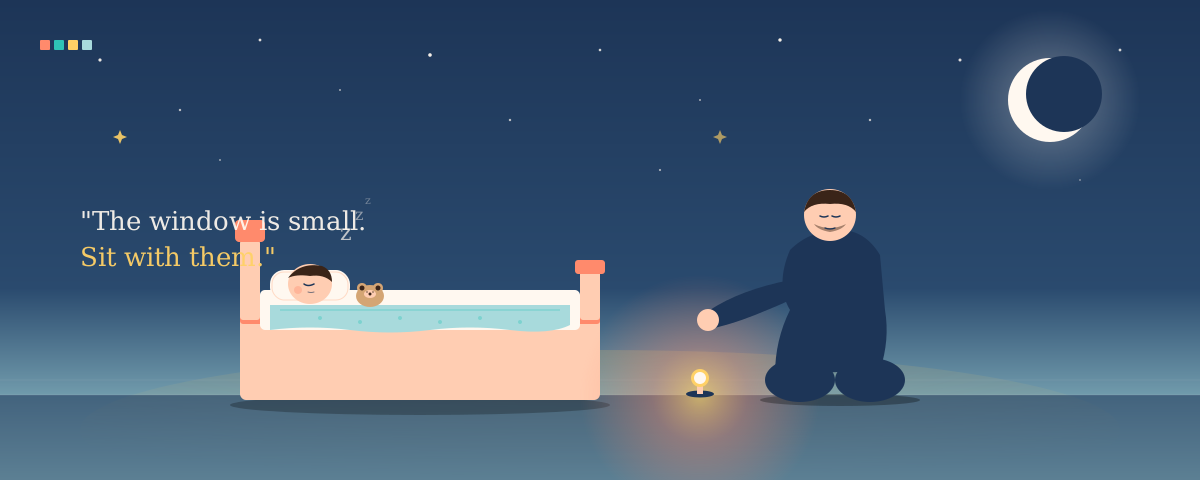
What I will say is this: if you have the bandwidth to sit with your kid at bedtime, even for a few minutes, even some nights, the evidence says it matters. Presence at bedtime is not coddling. Warmth at bedtime is not creating bad habits. The window in which a 3-year-old wants to sleep on the floor next to you so she can be close, or in which a 7-year-old still wants your arm around her at bedtime, is very small in the grand scheme. It does not last.
When my 3-year-old sleeps on the floor next to me, she is not doing it because something is wrong. She is doing it because she has been away from me, and she is making sure I am still here, and the floor next to Dad is the closest she can get. When my 7-year-old pulls my arm closer, she is doing the same thing in her own way. They both fight sleep at bedtime because they do not want the day to end. That is not pathology. That is a pretty rational response to spending time with someone you love and knowing the time is limited.
I sit with my kids until they fall asleep. The parenting internet has opinions about that. I have stopped having opinions about the parenting internet's opinions. The window is small. I am going to sit with them.
My Own Reckoning
I need to be honest in this section, because I do not want this post to read like I have it figured out.
I do not have it figured out.
I have rushed bedtime when I was tired. I have been short with my daughters when they wanted one more story and I was running on fumes. I have, on hard nights, mentally checked out while sitting next to them, scrolling on my phone instead of being present. I have had nights where the structure I am writing about in this post completely fell apart because I did not have the energy to hold it.
The research I have been citing is clear that the variable that matters most is consistency. I am not always consistent. Some nights I am the dad I want to be at bedtime. Some nights I am a tired man sitting on the edge of a bed.
What I have learned is that a bad bedtime does not undo the good ones, and the good ones do not require perfection. The research on parenting consistency is not asking for 100%. It is asking for enough. Enough warmth, enough predictability, enough presence that the pattern is recognizable to your kid.
When I have a bad bedtime, I try to repair the next day. I tell my daughters I was tired and grumpy and I was sorry I rushed. They are gracious about it in the way kids tend to be gracious, which is to say they have already moved on by the time I am still apologizing. I think the modeling matters more than the apology. I want them to see that adults make mistakes and own them, because someday they will be adults making mistakes and they will need to know how to own them too.
If you are a parent reading this and feeling guilty about the bedtimes you have rushed or the nights you mentally checked out, I want you to hear me clearly: that is not the part that breaks kids. The part that breaks kids is when bad bedtimes become the only kind of bedtime they ever get. If you are reading a long blog post on children's sleep, you are not that parent. The fact that you care is most of the work.
What I Actually Do at Bedtime
The structure that works in our house is not complicated, and it is not original. I am putting it here because sometimes when you are deep in the chaos of bedtime, it helps to see what someone else's looks like, even if you end up doing yours differently.
- Bath. Warm, not too hot. The bath is the official handoff between "day" and "evening." It signals to their nervous systems that the wind-down has started. It is also a moment for me. If I am stressed or worn down from the day, the bath is when I let myself take a deep breath. They play and splash and decompress, and I sit nearby and remember that I am allowed to do the same. Some of the best bedtimes start with the parent regulating first.
- Teeth. Boring. Necessary. Not a battle most nights, but a battle some nights. We do it anyway.
- Story. I read them a book. Sometimes the same book for weeks. Sometimes a new one. The point is the ritual, not the content. They both pile in close. My 3-year-old usually wants to "help" turn the pages and gets the order wrong. We figure it out.
- Talk about the day. This is the part I think other parents underrate. After the story, with the lights low, I ask them what their favorite part of the day was. What was hard. What they're thinking about. My 7-year-old tells me long, winding stories that loop back on themselves. My 3-year-old tells me about a bug or a dog or whatever was the most exciting thing. This is when the real conversations happen. This is when I learn things I would not learn any other time.
- Stay until they're asleep. This is where I deviate from a lot of the standard advice. I sit with them. My 3-year-old is on the floor. My 7-year-old has my arm. They fight sleep for a while, and then they don't. It usually takes 15 to 30 minutes. I do not consider this lost time. I consider this some of the most important time we spend together all weekend.
That's it. There is no special trick. The work is in showing up, every weekend night I have them, with as much presence as I can summon.
The Three Real Questions
Pull back and look at the pattern.
The first section was about a method debate that the research says is not the load-bearing variable. The second was about boring fundamentals that nobody wants to hear because they cannot be packaged and sold. The third was about kids whose nervous systems do not match the standard advice. The fourth was about a custody situation the research barely studies. Different topics, same pattern: parents are getting sold debates, products, and guilt as the answer to questions that are not the actual questions.
So what are the actual questions?
Three, as far as I can tell.
One: Is your kid getting enough sleep for their age and brain?
Most "behavior issues" in kids are sleep issues wearing a costume. If your kid is melting down, struggling at school, snapping at siblings, having trouble with attention, or generally behaving in ways you find hard to understand, the first question is not "what discipline strategy should I try?" The first question is "is this kid actually getting enough sleep?" Look at the AASM ranges. Look at your kid. Do the math honestly.
Two: Are the boring fundamentals in place?
Routine, timing, environment, screens. These are not exciting. They also do most of the work. If you are reaching for advanced interventions before you have nailed down "consistent bedtime, dim room, no devices in the bed," you are skipping a step.
Three: Are you, the parent, functional enough to keep showing up?
This is the question nobody asks parents and the question that matters most. You cannot run a consistent bedtime routine if you are running on four hours of sleep yourself. You cannot stay calm during the 9:47 p.m. third request for water if you are at the end of your rope. Your sleep matters. Your support system matters. The people around you taking care of you matters. If the bedtime in your house is collapsing, the answer might not be "find a better bedtime strategy." The answer might be "find more support for the adult who is running bedtime."
A few non-negotiable safety lines
For anyone reading this with a baby or a kid with concerning symptoms:
For infants, the AAP's 2022 safe sleep guidelines are not optional. Back to sleep, firm flat surface, no soft bedding, room-share without bed-share. Period.
Red flags for older kids that warrant a pediatrician or sleep specialist visit: loud regular snoring, gasping or pauses in breathing, persistent mouth breathing, extreme daytime sleepiness, frequent or severe parasomnias, significant insomnia that does not respond to environmental changes. Sleep-disordered breathing in kids gets missed all the time and can look like ADHD, behavior problems, or "just a tired kid." If something feels off, push for a real evaluation.
If You're Reading This
To the parent whose kid won't sleep no matter what they try: I see you. I have been the dad sitting on a bedroom floor at 11 p.m. wondering what I am doing wrong. The fundamentals matter. They also do not always work fast. Keep going. If you have been at it for weeks and nothing is moving, that is genuinely a conversation to have with your pediatrician, not a sign that you are failing.
To the parent of a neurodivergent kid: You already know the standard advice was not written for your kid. The fact that you have made it this far reading research-heavy blog posts means you are doing the work. Your kid is lucky. Take care of yourself too. The exhaustion of parenting a kid who does not sleep well is real, and it cannot be fixed by trying harder.
To the divorced or separated parent: You are not failing because the other house has different rules. You cannot control that. You can control your house. Make it a soft landing. Sit with them. Let them sleep on the floor if that is what they need to feel close. The window is small and the protective effect of one consistent home is real.
To the parent who feels guilty about the bedtimes they have rushed: The bad bedtimes are not the part that breaks kids. The pattern is what matters, not the individual nights. If you care enough to feel guilty, you are already most of the way there. Be kind to yourself. You are doing harder work than the world acknowledges. (I wrote about this same dynamic from a different angle — why one bad moment of yelling doesn't undo the pattern.)
To the parent who is just tired: Same. Genuinely. Same.
The Bottom Line
It's still that Saturday night.
My 7-year-old has finally stopped fighting sleep and is breathing the deep, slow breath of a kid who has surrendered. My 3-year-old, on the floor, is making the small sleep noises she makes when she is most of the way under. The room is warm. The light from the hallway is making a long stripe on the carpet. My arm is asleep from being pinned, and I do not move it, because if I move it she will wake up. And even if she did not wake up, I am not sure I want my arm back yet.
The parenting internet would have a lot of opinions about this scene. The actual research, when you read it carefully, says something different. It says: be close to your kid at bedtime. It says routine and warmth matter more than method. It says a kid who wants their parent close at bedtime is not a kid with a problem. They are a kid with a parent.
Parenting is hard. I do not know any parents who have it figured out, and the ones who claim they do are usually the ones whose kids are quietly figuring out how to fake it. The debates the internet wants you to have are mostly debates about how parents feel, not about what kids need. Your kid does not care which method you used. Your kid cares whether you were there.
If you take one thing from this very long piece, take this: be kind to the kid in front of you. Meet them where they are tonight, not where the book says they should be. Be kind to yourself, because the standards we hold parents to are absurd and you are doing better than you think. Sleep is important. So is the small human who is currently sleeping on the floor because the floor is closer to you than the bed.
The window is small. Sit with them.
Resources & Further Reading
Books:
- Solve Your Child's Sleep Problems by Richard Ferber
- The Happy Sleeper by Heather Turgeon and Julie Wright
- It's Never Too Late to Sleep Train by Craig Canapari, MD
- The Whole-Brain Child by Daniel J. Siegel and Tina Payne Bryson
Clinical and Evidence-Based Resources:
- American Academy of Pediatrics: HealthyChildren.org Sleep Resources
- American Academy of Sleep Medicine: Sleep Education
- Autism Treatment Network Sleep Toolkit
- Dr. Craig Canapari's Pediatric Sleep Blog
For Parents in Split-Custody Situations:
- OurFamilyWizard: Co-parenting communication and scheduling platform
- National Parents Organization: Resources on shared and parallel parenting
References
- Paruthi S, Brooks LJ, D'Ambrosio C, et al. Recommended Amount of Sleep for Pediatric Populations: A Consensus Statement of the American Academy of Sleep Medicine. J Clin Sleep Med. 2016;12(6):785-786. https://jcsm.aasm.org/doi/full/10.5664/jcsm.5866
- Gradisar M, Jackson K, Spurrier NJ, et al. Behavioral Interventions for Infant Sleep Problems: A Randomized Controlled Trial. Pediatrics. 2016;137(6):e20151486. https://pubmed.ncbi.nlm.nih.gov/27225317/
- Mindell JA, Telofski LS, Wiegand B, Kurtz ES. A nightly bedtime routine: impact on sleep in young children and maternal mood. Sleep. 2009;32(5):599-606. https://pmc.ncbi.nlm.nih.gov/articles/PMC2675894/
- Mindell JA, Kuhn B, Lewin DS, Meltzer LJ, Sadeh A. Behavioral treatment of bedtime problems and night wakings in infants and young children. Sleep. 2006;29(10):1263-1276. https://aasm.org/resources/practiceparameters/review_nightwakingschildren.pdf
- Carter B, Rees P, Hale L, Bhattacharjee D, Paradkar MS. Association Between Portable Screen-Based Media Device Access or Use and Sleep Outcomes: A Systematic Review and Meta-analysis. JAMA Pediatr. 2016;170(12):1202-1208. https://pubmed.ncbi.nlm.nih.gov/27802500/
- Cortese S, Faraone SV, Konofal E, Lecendreux M. Sleep in children with attention-deficit/hyperactivity disorder: meta-analysis of subjective and objective studies. J Am Acad Child Adolesc Psychiatry. 2009;48(9):894-908. https://pubmed.ncbi.nlm.nih.gov/19625983/
- Van der Heijden KB, Smits MG, Van Someren EJ, Gunning WB. Idiopathic chronic sleep onset insomnia in attention-deficit/hyperactivity disorder: a circadian rhythm sleep disorder. Chronobiol Int. 2005;22(3):559-570. https://pubmed.ncbi.nlm.nih.gov/16076654/
- Souders MC, Zavodny S, Eriksen W, et al. Sleep in Children with Autism Spectrum Disorder. Curr Psychiatry Rep. 2017;19(6):34. https://pmc.ncbi.nlm.nih.gov/articles/PMC7837521/
- Mazurek MO, Petroski GF. Sleep problems in children with autism spectrum disorder: examining the contributions of sensory over-responsivity and anxiety. Sleep Med. 2015;16(2):270-279. https://pubmed.ncbi.nlm.nih.gov/25600781/
- El-Sheikh M, Buckhalt JA, Mize J, Acebo C. Marital conflict and disruption of children's sleep. Child Dev. 2006;77(1):31-43. https://pubmed.ncbi.nlm.nih.gov/16460523/
- Moon RY, Carlin RF, Hand I; Task Force on Sudden Infant Death Syndrome. Sleep-Related Infant Deaths: Updated 2022 Recommendations for Reducing Infant Deaths in the Sleep Environment. Pediatrics. 2022;150(1):e2022057990. https://publications.aap.org/pediatrics/article/150/1/e2022057990/188304/
- American Academy of Sleep Medicine. Child Sleep Duration Health Advisory. https://aasm.org/advocacy/position-statements/child-sleep-duration-health-advisory/
Have questions or experiences to share? I'd love to hear from other Magic Valley parents navigating these same challenges. Drop a comment below or reach out through the blog contact form.
Tags
Written by
Steadykeep
Published
May 5, 2026