Can My Kid Do Activities If I Only Have Them Every Other Week? What the Research Actually Says
The research on shared custody and kids' activities doesn't say what the enrollment forms assume. Here's what the evidence on skill learning, dropout, and joint custody actually shows, and where it stays honestly silent.
I went into the building to ask about dance in person, which in hindsight tells you how much explaining I expected to have to do.
I told the receptionist what our schedule was: I have my daughters every other week, and on the off weeks they would not be there. Could that work, and what would we do about it?
She said they had done that before, and then there was a pause, long enough that I started filling it myself. I offered to pay for the whole session rather than only the weeks my kids would actually attend.
That was the compromise we landed on, and it was the one that worked. I paid for eight weeks so that they could come to four, and I was more than happy with it.
Why I Started Looking at the Research
If you've typed some version of "activities for kids with shared custody" or "can my kid do gymnastics if I only have them every other week" into a search bar, you already know what's waiting for you. Family-law firm blogs about parenting plans. Co-parenting app ads. Lists of digital calendars to help you and your ex coordinate. Somewhere in there, a well-meaning article telling you to "communicate openly" and "put the kids first."
What's almost never there is the question underneath the logistics question: does it actually matter, developmentally, if my kid only gets to a weekly activity every other week? Is skipping half the sessions going to leave them behind, or discouraged, or worse off than the kid who shows up every Tuesday? Or is that worry doing more work in my head than it deserves?
That's a research question, not just a scheduling one. And it turns out there's real evidence that speaks to it, evidence that almost none of the parenting-logistics content bothers to look up, because it's easier to sell a shared calendar app than to answer whether the thing you're calendaring even needs to happen every week to count.
This site exists because of a version of this exact problem. I'll get into that later. First, the research.
What Actually Predicts Whether a Missed Session Costs a Kid Anything
The intuitive fear goes like this: skill-building activities work through repetition, repetition requires consistency, and "every other week" is half the repetition of "every week." So a kid on an alternating schedule is getting half the benefit, or worse, falling behind their weekly-attending peers in a way that compounds.
The research on how humans actually learn skills tells a more complicated, and more reassuring, story.
Spacing out practice is not the same thing as wasting practice. One of the most replicated findings in learning science is the "spacing effect": when the same amount of practice is spread across more time, with longer gaps between sessions, retention is often better than when the same practice is crammed close together. A large synthesis of the distributed-practice literature (839 separate comparisons pulled from 317 experiments across 184 studies) found that spacing out learning sessions reliably improved memory retention compared to massed, back-to-back practice, across a wide range of tasks and populations.[1] A separate study looking specifically at a physical, motor skill (not a memory task) found the same pattern: participants who practiced with sessions spaced a full day apart retained the skill better on a later test than participants who practiced the same total amount with only 20 minutes between sessions.[2]
I want to be precise about what this evidence does and does not say, because it would be easy to overstate it. Both of these studies tested spacing measured in minutes to about a day, in controlled lab conditions, on relatively simple tasks (word lists, a timed motor sequence). Neither tested a 5-year-old doing a 45-minute dance class every two weeks for a semester. Extending "spacing sessions by a day helps retention more than spacing them by 20 minutes" to "spacing sessions by two weeks is fine for a kid learning a cartwheel" is a real extrapolation, and I'm flagging it as one rather than pretending the research answers the specific question parents are asking. What the spacing literature does establish, solidly, is that the core assumption behind the worry (that more frequent equals better retained, full stop) is not how learning actually works. Forgetting some of what happened last session and having to re-find it is not evidence that the practice "didn't count." In a lot of cases, that re-finding is where the durable learning actually happens.
What predicts whether a kid keeps going, and keeps benefiting, isn't attendance count, it's the relationship. This is the part of the research that surprised me most, because it reframes the whole worry. Youth sports has been studied heavily on exactly this question, not "how much practice is needed" but "what makes a kid stay in, versus quit." A systematic review and meta-analysis of prospective studies on adolescent team-sport dropout found that the strongest and most consistent predictors of a kid leaving a sport were motivational and relational: things like feeling controlled rather than autonomous, low enjoyment, and weak relationships with coaches and teammates.[3] A large, more targeted study of adolescent soccer players used the same design to build a specific risk profile for drop-out, and found that experiencing less autonomy support from the coach and lower intrinsic motivation were among the clearest predictors, alongside socioeconomic status and older age.[4] A separate study looking specifically at the coach-athlete relationship found that coaching behavior that supported a kid's sense of competence had a measurable effect on whether that kid intended to keep playing.[5]
None of these studies asked "does missing every other week predict dropout," because that specific question doesn't seem to have been studied directly, a gap I'll come back to. But notice what these studies did find drives whether a kid sticks with something and gets something out of it: the quality of the relationship with the adult running it, and whether the kid feels like a person there rather than a body filling a slot. Attendance frequency isn't on that list. That doesn't prove attendance frequency is irrelevant. It means the strongest evidence available points somewhere else entirely, toward something a biweekly-schedule kid can have in full: a coach or instructor who knows their name and is glad to see them, whichever week they show up.
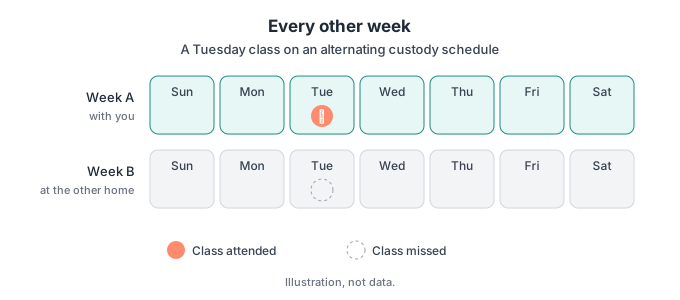
The Myth: "If You Can't Commit Every Week, Don't Bother Signing Up"
This is the message a lot of shared-custody parents absorb, sometimes explicitly from a program's enrollment policy and sometimes just from the shape of how activities are marketed: weekly, ongoing, full-season commitment expected. If you can't guarantee that, the implied message is that you shouldn't take the spot from a kid who can.
There's a real version of this that's fair. Some activities genuinely are sequential in a way that matters (a beginner swim class that teaches breath control before strokes, a martial arts belt curriculum, a music method book) and a kid who misses the class where a foundational piece got introduced may need a bit of catch-up. That's a real, practical consideration, and it's worth asking an instructor about directly rather than assuming it either way.
But the broader claim (that inconsistent attendance makes an activity not worth doing, or actively sets a kid back relative to where they'd be doing nothing) doesn't hold up against what the developmental research on extracurricular participation actually measures. The research on "breadth" of extracurricular involvement (how many different activities and domains a kid is engaged in, tracked over a school year) finds positive associations with academic adjustment and lower rates of problem behavior, with the benefit leveling off (not reversing) at very high levels of involvement.[6] That's participation measured across a semester or a year, the scale at which the actual research operates. It says something about whether being involved matters. It says nothing about whether every single scheduled session has to be attended to get any of that benefit, because that isn't the question the literature was built to answer.
A more recent international study looking at extracurricular arts and sports participation and adolescents' social-emotional skills found a positive association between participation and skills like self-control, curiosity, and sociability, with the strongest effects for students combining multiple types of activities.[7] Again: this measures whether a kid participates, not whether they hit 100% attendance. The unstated assumption in "don't bother if you can't commit fully" (that partial participation is functionally equivalent to no participation) isn't a finding from this literature. It's an inference nobody has actually tested, dressed up as if it were settled.
The Boring Fundamentals: What the Evidence Says Activities Are Actually For
Strip away the scheduling anxiety and the research on why kids benefit from organized activities in the first place is pretty unglamorous, which is exactly why it's worth stating plainly.
The American Academy of Pediatrics' clinical guidance on organized sports for children and adolescents lists the core benefits: physical activity habits that carry into adulthood, peer socialization, teamwork and leadership skills, self-esteem, coordination and movement skills, and, critically, that kids stay involved and get these benefits over time specifically when the experience is fun and development-focused rather than centered on winning or performance pressure.[8] Enjoyment, not attendance perfection, is the thing the AAP's own guidance flags as the actual predictor of a kid staying engaged long enough to get anything out of it.
Consistency still matters, just not in the specific form parents tend to assume. A systematic review of 170 studies on routines and child development found routines are broadly associated with better cognitive, self-regulatory, social-emotional, and academic outcomes, and that this protective effect is strongest precisely in environments that are otherwise less predictable.[9] That's a real point in favor of structure, but notice what "routine" means in this literature: a reliable, repeated pattern a child can count on. An every-other-week activity that happens on the same day, at the same time, every time you have your kid, is a routine in exactly this sense. It's a predictable pattern layered onto an already-predictable custody schedule. "On my weeks, we do gymnastics on Thursday" is not the absence of routine. It's a routine sized to fit the actual schedule, which is a different thing from an inconsistent one.
When the Standard Advice Doesn't Fit: Custody, Cost, and the Kids the System Wasn't Built For
Almost every activity in your community (the sign-up forms, the season structure, the pricing) was designed around an assumption: one household, two cooperating parents (or one parent handling logistics solo), a kid who's there every single week because there's only one place for them to be.
That assumption creates a real, measurable gap, and it's worth naming honestly instead of treating it as a personal failure to plan better.
Family structure and income both predict lower participation, independent of any question about whether missing sessions matters. U.S. Census Bureau data on children's activities found that household structure was associated with participation rates in sports, lessons, and clubs. Children living with two married parents in one household had higher participation than children in other family structures, and children in poverty were less likely to participate in each of the three activity types than children who weren't.[10] A separate study using national panel data on adolescents in Sweden found a more specific mechanism: while most families' participation wasn't sensitive to small income changes, a drop in household income specifically predicted an adolescent stopping an activity they were already doing among lower-income households.[11] Divorce and separation frequently come with exactly that kind of income disruption, on top of the logistics disruption. The two compound.
None of the research above was designed to study shared-custody families specifically, and that is itself worth saying plainly. I could not find a single peer-reviewed study asking the precise question a lot of separated parents are actually asking: does an alternating-week or alternating-weekend schedule, by itself, predict lower extracurricular participation or worse outcomes from the activities a kid does attend? What exists instead is family-law commentary and co-parenting-app marketing content, which is useful for logistics but isn't evidence. The honest answer is that this specific intersection, custody schedule structure and activity participation or benefit, is a gap in the literature, not a settled question with an answer I'm choosing not to tell you.
For very young children, there's a separate and genuinely unresolved research argument, about custody schedules generally, not activities specifically. If "signing kids up for anything" includes toddlers and preschoolers, it's worth knowing that researchers disagree, sometimes sharply, about how much overnight time away from a primary attachment figure very young children should have. One widely cited study using a large, nationally representative U.S. sample found that one-year-olds with frequent overnights away from their primary caregiver showed more irritability and reduced secure-base behavior at later assessment, and two- and three-year-olds with a high proportion of overnight time away showed lower persistence in play, associations the authors interpreted as markers of attachment insecurity.[12] That paper was formally challenged in the same journal: two other researchers published a comment arguing the measures were imprecise and that some findings were presented more strongly in media coverage than the data supported; the original authors published a rejoinder defending their design and, notably, argued that in the absence of clear evidence either way, the burden of proof about what's "safe" shouldn't automatically default to less parenting time with the non-primary parent.[13] That argument, about where the burden of proof sits when the evidence itself is ambiguous, is in my read the most honest summary of where this literature actually stands. It is contested, it is not close to settled, and I'm not going to pretend otherwise or pick a side dressed as a finding. If you have a child under three and you're weighing overnight frequency specifically, that's a conversation for a child psychologist or family therapist who can look at your actual kid, not a blog post.
For neurodivergent kids, the custody-schedule mismatch layers onto a transition-tolerance mismatch that's already documented. I've written before about how much standard parenting advice (on sleep, on routines) simply assumes a nervous system that doesn't match every kid, and my oldest is one of the kids it doesn't match.[^ref-sleep] The same gap shows up here: a kid who already finds transitions between households effortful may find "sometimes we go to gymnastics, sometimes we don't, depending on the calendar" adds real cognitive load on top of that, in a way a kid without that difference might not notice. That's a reason to be thoughtful about which activities you choose and how they're introduced (a highly structured, low-transition activity may genuinely serve a neurodivergent kid on an alternating schedule better than one with more variability), not a reason to conclude the activity isn't worth attempting.
What the Broader Evidence Actually Says About Kids Who Grow Up Between Two Houses
It's worth stepping back from activities specifically, because a lot of the anxiety under this whole topic isn't really about the soccer schedule. It's the quieter question: am I doing something harmful to my kid just by having them live on an alternating schedule at all?
Here the evidence is more consistent than the activities-specific gap above, and more reassuring than most of what circulates. A review of 60 studies comparing children in joint physical custody to children in sole physical custody arrangements found that the large majority (34 of the 60) showed better outcomes for joint-custody children across measures of behavioral, emotional, physical, and academic well-being, with better relationships with parents and even grandparents; another 14 found a mix of equal and better outcomes; only 6 found the two arrangements equivalent across the board, and none in this review favored sole custody.[14] A separate, very large study using a Swedish national classroom survey of 164,580 children ages 12 and 15 compared subjective wellbeing across joint physical custody, living mostly with one parent, and nuclear families, and found children in joint physical custody reported better wellbeing, family life, and peer relations than children living mostly or only with one parent.[15]
Two honest caveats belong right alongside that reassurance. First, almost all of this evidence is correlational. It compares families who ended up in different arrangements, and families who choose or are assigned joint custody may differ in ways (lower ongoing conflict, more resources, more cooperative co-parenting) that also independently predict better outcomes. The research can't fully separate "joint custody helped" from "the kind of family that manages joint custody well was already doing okay." Second, both of these are large, well-powered studies, but they are looking at school-age children and young teenagers, which is exactly the age range where most of the activities-scheduling question above actually applies. They're not making claims about infants or toddlers, which is the separate, contested territory described above.
Put together: the broader evidence that alternating-custody living arrangements are workable, even beneficial, for a school-age kid's general wellbeing is fairly strong. The specific evidence about whether an alternating schedule limits the value of the activities that kid participates in essentially doesn't exist yet. Those are different questions, and it's worth not letting worry about the first bleed into false certainty about the second.
My Own Reckoning
I've told part of this story before, in the post that explains why this site exists at all, so I'll be straightforward that what follows is a recap rather than something new. The facts are already public, I'm just putting them next to the research above.[^ref-origin]
When my daughters were younger, I wanted to get them into activities. Simple idea. What I ran into was that almost every program in reach met weekly, expected the same kid in the same seat every single week, and had no real answer for "what if I only have her every other week." I offered to cover the full cost and handle every bit of the logistics on my end. What I needed was the other household's cooperation to fill in the weeks that weren't mine, so the spot didn't sit empty and the enrollment didn't get pulled. That cooperation never came. Not out of malice that I can prove, just friction, and maybe a version of exactly the worry this whole post is trying to research: is this even worth the hassle if we can't do it right?
I kept looking instead of concluding the answer was no. Eventually I found a gymnastics program willing to take her on the weeks I actually had her. My oldest was terrified of the balance beam the first time she tried it. She'd take one step and freeze. Every-other-week, for a summer, I watched that change, not in a straight line, and not as fast as a kid attending every week probably would have. By the end of that summer she was walking the beam with her head up.
I don't know, and I'm not going to pretend the research tells me, whether she'd have gotten there faster on a normal weekly schedule. What I do know is that the version of the advice everyone gives (don't bother if you can't commit fully) would have meant she never got on the beam at all. The spot that actually worked wasn't the one that matched the "right" schedule. It was the one that took her anyway.
What To Do Instead
- Ask about the actual policy before you assume you're disqualified. "Do you have a drop-in rate, a makeup-class policy, or the option to attend only on alternating weeks?" is a normal question, not a special favor. Some programs will say no. A meaningful number will say yes if asked directly, because an empty spot costs them money too.
- Weight the relationship over the attendance record when you're choosing between programs. Given what the dropout research actually shows drives whether a kid sticks with and benefits from an activity (the coach or instructor, not the session count[3][4][5]), a warm, attentive instructor at a flexible program is a better bet than a rigid program with a slightly better reputation.
- Build a routine sized to the schedule you actually have, not the one you wish you had. "On my weeks, we do this on this day" is a real routine, and the research on routines' protective value doesn't require it to happen every single week. It requires it to be predictable when it happens.[9]
- For sequential-skill activities, ask directly what gets missed. If a program teaches in a strict sequence, ask the instructor what a kid on your schedule would need to catch up on, and whether that's realistic to handle at home or in a quick five minutes before or after a session. Most instructors have dealt with this before, even if their enrollment form doesn't mention it.
- Don't let the standard advice talk you out of trying before you've actually asked. The loudest message (full commitment or don't bother) isn't a research finding. It's an assumption baked into how most programs were designed, for a kind of family that isn't every family.
- If you find a program that actually works with your schedule, say so where other parents can find it. This is the part I built into this site directly, because I couldn't find this information myself when I needed it. If a business, class, or program in your community genuinely works around a shared-custody schedule (makeup sessions, drop-in rates, flexibility with no penalty), file a custody-friendly report so another parent doesn't have to run the same search I did. It takes about a minute, and it's the only place I know of doing this specifically. (Right now this directory covers Idaho communities and is expanding. If you're elsewhere, the question is still worth asking your own local programs directly, even without a place yet to record the answer.)
When to Get Help
Most of what this post covers is a logistics and evidence question, not a crisis one, and I don't want to manufacture urgency where there isn't any. A few situations do warrant more than a blog post, though:
- If scheduling disagreements about activities have become a recurring flashpoint between co-parents (not just friction, but a pattern where activities get used as leverage, or where one parent consistently blocks participation as a way to control the other), a parenting coordinator or family mediator is built for exactly this, and is a genuinely different tool than trying to negotiate it directly every time.
- If you're the parent losing scheduled time specifically because of activity commitments and it's straining your relationship with your kid, that's worth raising with a family therapist rather than absorbing silently. The research above doesn't say your time matters less than the activity does.
- If a co-parent is using scheduling, activities, or access to your child as a tool of ongoing control or intimidation rather than a genuine disagreement about logistics, that's a different category of problem, and it deserves support built for it: the National Domestic Violence Hotline (1-800-799-7233) works with situations involving coercive control around children and custody, not just physical violence.
- If you have a child under three and you're genuinely unsure about overnight frequency given the contested research described above, that's worth a conversation with a child psychologist or family therapist who can assess your specific child, rather than a decision made from a blog post either way.
If You're Reading This
To the parent who decided not to even try because the logistics seemed impossible: the research doesn't back up the assumption that stopped you. Ask the program directly. You might be surprised.
To the parent of a very young child, worried specifically about overnight frequency: the researchers studying this disagree with each other, publicly and pointedly. You're not failing to find a clear answer because you haven't looked hard enough. There isn't one yet. That's a reasonable thing to bring to a professional who knows your kid, not a verdict to reach alone at midnight.
To the co-parent who feels guilty about the weeks you don't have your kid at practice: the evidence on what actually predicts whether a kid benefits from an activity points toward the relationship with the coach and whether the kid enjoys it, not toward which parent had them on a given Tuesday. That guilt is understandable. It isn't backed by what the research actually measures.
To the parent who found a program that finally said yes: that's not a small thing, and it's worth telling other parents about it. You're the reason the next family doesn't have to make as many phone calls as you did.
The Bottom Line
The core fear behind this whole question (that an every-other-week schedule quietly shortchanges a kid, either through the custody arrangement itself or through inconsistent participation in the activities layered on top of it) doesn't hold up well against the evidence that actually exists. The broader research on joint physical custody and school-age children's wellbeing is genuinely reassuring, with real caveats about correlation and about very young children specifically. The research on skill learning says spacing out practice is not the same thing as wasting it. The research on why kids stick with and benefit from activities points at the relationship with the adult running it, not the attendance sheet.
What doesn't exist yet is research on the precise intersection (custody schedules and activity participation, studied together), and I'd rather tell you that plainly than pretend the adjacent research answers it for you. What exists in its place is mostly assumption, dressed up by program policies and family-law blogs as settled fact. It isn't. Ask the question directly, to the actual program, before you let the assumption make the decision for you.
Resources & Further Reading
Books:
- Mom's House, Dad's House: Making Two Homes for Your Child by Isolina Ricci, the standard reference on structuring logistics, routines, and two-household parenting, not specific to activities but useful for the broader scheduling picture.
Organizations:
- National Parents Organization (sharedparenting.org): research and practical resources on shared-parenting logistics and coordination.
On this site:
- Why I Built This: A Dad's Mission to Make Parenting Resources Accessible, the origin story behind the custody-friendly directory referenced above.
- Why Your Kid Isn't Sleeping, more on parenting across two households, including bedtime routines that travel.
- Why Your "Defiant" Kid Might Actually Be Anxious, relevant if transitions between households are showing up as behavior rather than words.
- Custody-friendly activities directory (Idaho), where parents report which local programs actually work with a shared-custody schedule. It is new, so the first reports are still coming in.
If a custody or scheduling conflict has become coercive rather than logistical:
- National Domestic Violence Hotline: 1-800-799-7233
References
↑ [1]: Cepeda NJ, Pashler H, Vul E, Wixted JT, Rohrer D. Distributed practice in verbal recall tasks: A review and quantitative synthesis. Psychological Bulletin. 2006;132(3):354-380. Available at: https://escholarship.org/uc/item/3rr6q10c
↑ [2]: Shea CH, Lai Q, Black C, Park JH. Spacing practice sessions across days benefits the learning of motor skills. Human Movement Science. 2000;19(5):737-760. Available at: https://doi.org/10.1016/S0167-9457(00)00021-X
↑ [3]: Back J, Johnson U, Svedberg P, McCall A, Ivarsson A. Drop-out from team sport among adolescents: A systematic review and meta-analysis of prospective studies. Psychology of Sport and Exercise. 2022;61:102205. Available at: https://doi.org/10.1016/j.psychsport.2022.102205
↑ [4]: Back J, Stenling A, Solstad BE, Svedberg P, Johnson U, Ntoumanis N, Gustafsson H, Ivarsson A. Psychosocial Predictors of Drop-Out from Organised Sport: A Prospective Study in Adolescent Soccer. International Journal of Environmental Research and Public Health. 2022;19(24):16585. Available at: https://doi.org/10.3390/ijerph192416585
↑ [5]: Wekesser MM, Harris BS, Langdon J, Wilson CH. Coaches' impact on youth athletes' intentions to continue sport participation: The mediational influence of the coach-athlete relationship. International Journal of Sports Science & Coaching. 2021. Available at: https://doi.org/10.1177/1747954121991817
↑ [6]: Fredricks JA, Eccles JS. Extracurricular involvement and adolescent adjustment: Impact of duration, number of activities, and breadth of participation. Applied Developmental Science. 2006;10(3):132-146. Available at: https://doi.org/10.1207/s1532480xads1003_3
↑ [7]: Wang W, Li W, Yao J. The Relationship between Participation in Extracurricular Arts and Sports Activities and Adolescents' Social and Emotional Skills: An Empirical Analysis Based on the OECD Social and Emotional Skills Survey. 2024. Available at: https://pubmed.ncbi.nlm.nih.gov/39062364/
↑ [8]: American Academy of Pediatrics, Council on Sports Medicine and Fitness. Organized Sports for Children, Preadolescents, and Adolescents. Pediatrics. 2019;143(6):e20190997. Available at: https://publications.aap.org/pediatrics/article/143/6/e20190997/37135/
↑ [9]: Selman SB, Dilworth-Bart JE. Routines and child development: A systematic review. Journal of Family Theory & Review. 2024;16(2):272-328. Available at: https://doi.org/10.1111/jftr.12549
↑ [10]: U.S. Census Bureau. A Child's Day: Parental Interaction, Extracurricular Activities, and School (based on the Survey of Income and Program Participation). Available at: https://www.census.gov/newsroom/archives/2014-pr/cb14-224.html
↑ [11]: Hjalmarsson S. Pay to play? Economic constraints and participation in extracurricular activities. European Sociological Review. 2023;39(4):586-600. Available at: https://doi.org/10.1093/esr/jcac061
↑ [12]: Tornello SL, Emery R, Rowen J, Potter D, Ocker B, Xu Y. Overnight Custody Arrangements, Attachment, and Adjustment Among Very Young Children. Journal of Marriage and Family. 2013;75(4):871-885. Available at: https://doi.org/10.1111/jomf.12045
↑ [13]: Millar P, Kruk E. Maternal Attachment, Paternal Overnight Contact, and Very Young Children's Adjustment: Comment on Tornello et al. (2013). Journal of Marriage and Family. 2014;76(1):232-236. Available at: https://doi.org/10.1111/jomf.12071. Tornello and Emery's rejoinder ("Who Assumes the Burden of Proof When There's No Neutral Null Hypothesis?") is available at: https://doi.org/10.1111/jomf.12070
↑ [14]: Nielsen L. Joint Versus Sole Physical Custody: Children's Outcomes Independent of Parent-Child Relationships, Income, and Conflict in 60 Studies. Journal of Divorce & Remarriage. 2018;59(4):247-281. Available at: https://doi.org/10.1080/10502556.2018.1454204
↑ [15]: Bergström M, Modin B, Fransson E, Rajmil L, Berlin M, Gustafsson PA, Hjern A. Living in two homes-a Swedish national survey of wellbeing in 12 and 15 year olds with joint physical custody. BMC Public Health. 2013;13:868. Available at: https://pubmed.ncbi.nlm.nih.gov/24053116/
[^ref-sleep]: See "Why Your Kid Isn't Sleeping" for more on parenting a nervous system that doesn't match standard advice, and on building routines across two households.
[^ref-origin]: See "Why I Built This: A Dad's Mission to Make Parenting Resources Accessible" for the full story this section recaps.
Tags
Written by
Steadykeep
Published
September 23, 2026