What Actually Predicts How Kids Do After a Divorce (And Why It Is Almost Never the Divorce Itself)
The research on children and divorce has been badly reported for forty years. The average effect is real and small, a large share of it was measurable before the separation, and the factor that carries most of the damage is one a parent can change alone.
She asked me at bedtime, half past eight, after a bath, at the end of a day that had been genuinely good. One of those days where nothing goes wrong, and you notice that nothing went wrong.
"Dad, are you a good person?"
My first thought was not an answer. It was where is this coming from, and I could feel myself starting to pull on that thread, so I put it down and asked her what she thought instead. She told me I was a good person, in the flat, settled way kids say something they have already decided.
I am not going to write about where that question came from, or what I think it cost her, because that part is not mine to publish. What I will say is that my oldest had to arrive somewhere before a question like that occurs to her at the end of a good day, and that whatever the separation did or did not do to my daughters, it took something out of her that I cannot point to on a chart.
Why I Started Looking at the Research
The question almost every separated parent eventually types into a search bar at midnight is some version of the same one. How much did this hurt them?
What comes back is two industries talking past each other. One says children of divorce are damaged, and hands you a list of frightening statistics with no context and no sample sizes. The other says kids are resilient and they will be fine, which sounds kind and is useless, because it does not tell you what to do on Tuesday.
Neither answers the question you are actually asking. You are not asking about children in general. You are asking about yours, in your house, with your particular arrangement and your particular amount of tension, and you want to know which of the things you are worried about actually matter and which ones you can stop carrying.
There is a real answer to that. It has been studied for forty years, across meta-analyses covering hundreds of studies, longitudinal cohorts with tens of thousands of children, twin designs built specifically to rule out the obvious objections, and randomised trials that tested whether any of it could be changed. The answer is not the one either industry sells.
The short version: the legal event is close to the least important variable in the whole picture. What predicts how children do is a handful of family processes that run before, during and after the separation. Most of them are not fixed. Several of them are things one parent can move without any cooperation from the other adult at all.
That last sentence is the reason I wanted this post to exist.
What the Numbers Actually Say, and What an Average Means for One Child
Start with the honest version of the bad news, because you have been given the dishonest version already.
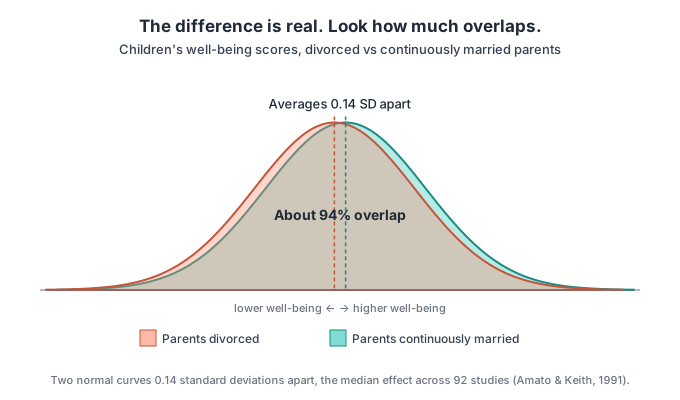
The foundational meta-analysis pooled 92 studies comparing children in divorced single-parent families with children in continuously intact families across a range of well-being measures. It found children of divorce scored lower, and it reported the median effect size as **0.14 of a standard deviation**.[1] A follow-up analysis a decade later pooled 67 more studies from the 1990s and found the same pattern persisting across academic achievement, conduct, psychological adjustment, self-concept and social relations.[2]
So the difference is real. It is not zero, and anyone telling you it is zero is not reading the same papers.
Now here is what 0.14 of a standard deviation means, because this is where almost every article you will find goes wrong. It is a difference between two group averages. Picture two bell curves laid over each other. They are not side by side. They are stacked almost exactly on top of one another, shifted by a sliver. The overwhelming majority of children in the divorced group fall inside the range of the children in the married group, and a very large number of them score above that group's average.
An average difference that small tells you almost nothing about any individual child. It tells you about a population. If you are reading this because you want to know about the child asleep down the hall, the population average is the wrong instrument, and a headline built on it is a scare story wearing a lab coat.
The absolute numbers say the same thing in plainer language. A Danish study followed 31,519 children from a national birth cohort and measured mental health at age 11 using a standard screening questionnaire completed by mothers. Among children in a nuclear family, 8.9% scored in the high- difficulty range. Among children whose parents had separated, the adjusted odds of a high score were 1.25 times that for children in joint physical custody, and 1.63 to 1.72 times for children in sole care arrangements.[3]
Convert those odds back to rates at that baseline and you land somewhere around 11% to 14%. That is my arithmetic on their adjusted odds ratios rather than a figure the authors printed, and odds ratios overstate risk when an outcome is this common, so treat it as a rough shape rather than a precise number. The shape is the point. The rate goes up. It stays low. In every arrangement they measured, something like six in seven children were not in the high-difficulty range at all.
Hold both of those facts at once. An increase in risk that is genuine, and a large majority of children who are doing fine. Most writing on this topic drops one or the other, because one of them sells fear and the other sells reassurance, and the truth sells neither.
The Divorce Is Not the Event. It Is the Middle of a Process.
Here is the finding that reframes everything, and it is old enough that there is no excuse for how rarely parents are told about it.
In 1991 researchers took two national longitudinal studies, one British and one American, and did something the earlier research had not. They found children who were living in two-parent families at the first interview, and followed them to the next one. Some of those families separated in between. Some did not. Because the children had been assessed before anything happened, the researchers could ask whether the problems measured afterwards had actually appeared afterwards.
For boys, the apparent effect of separation on behaviour problems and achievement was **sharply reduced** once you accounted for behaviour problems, achievement levels and family difficulties that were already present before any of the families broke up. For girls the reduction was smaller, but still noticeable.[4]
A large share of what gets attributed to divorce was already there. The separation did not create it. The separation is when researchers, and often parents, finally started measuring it.
This matters enormously for the reader I am writing to, so let me say it without hedging. If your child struggled after the separation, you do not get to conclude that the separation caused the struggle. You were living in the house. You know what the year before looked like.
The obvious objection is that this cuts too far the other way. Maybe the whole association is selection, and divorce does nothing at all. Researchers went after that objection directly, using a design called Children of Twins, which compares the children of adult twins who differ in whether they divorced. Because the twins share genes and a childhood environment, the design strips out a large chunk of the confounding that ordinary studies cannot touch.
The results were split, and the split is informative. In one study the association between parental divorce and offspring substance-use problems held up after controlling for genetic and environmental risk from the twin parent, which is consistent with a causal connection. The association with internalising problems, meaning anxiety and depression, did not. That one looked like shared genetic liability between parents and children rather than an effect of the separation.[6] An earlier study in the same programme, using Australian twin families, found environmental influences associated with divorce accounted for the higher rates of psychopathology across drug and alcohol, behavioural and internalising problems.[5]
Two careful studies, from the same research group, using related designs, reaching partly different conclusions. That is what a genuinely hard empirical question looks like from the inside. Neither "divorce ruins kids" nor "it is all genetics" survives contact with this literature.
What has survived, and what a 2022 review of the whole field concluded after synthesising decades of findings, is the reframe: it is the pre-divorce and post-divorce family environment that primarily accounts for how children do, rather than the legal divorce itself.[7]
Divorce is not an event that happens to a child. It is a long process, and the child's outcome is shaped by what the process contains.
What Actually Carries the Effect: Being Inside the Conflict, Not Near It
So what is in the process? The single most consistently identified factor, across every review, is conflict between the parents.[7] The original 1991 meta-analysis tested three competing explanations for the divorce effect, and found some support for parental absence and for economic disadvantage, but the most consistent support for a family conflict perspective.[1]
This is where most articles stop, and stopping here is the thing that makes them useless. "Reduce conflict with your co-parent" is advice that requires the other adult's cooperation, which is exactly what a large number of readers do not have and cannot get. A parent who has been handed that advice and cannot act on it ends up worse off than before they read it.
Go one level deeper into the mechanism and the picture changes completely.
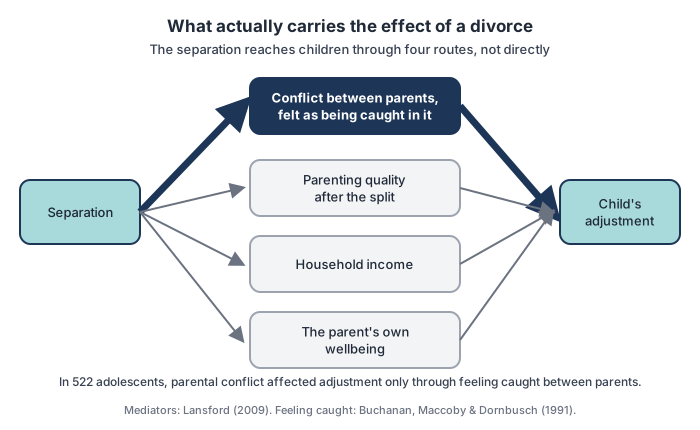
In a study of 522 adolescents interviewed four and a half years after their parents separated, researchers measured something specific: not how much the parents fought, but how much the adolescent felt caught between them. Feeling caught was related to poor adjustment outcomes. And the key result, stated plainly in the paper, was that parental conflict was related to adjustment outcomes only indirectly, through the adolescent's feelings of being caught.[8]
Read that again, because it is the most actionable sentence in this entire body of research. The conflict did not reach the children directly. It reached them through their position inside it.
The 2022 review reaches the same conclusion from the other direction. Children's feeling caught between parents, or experiencing loyalty dilemmas, contributes to poor adjustment after divorce, and children can adjust well to divorce if parents maintain clear boundaries with children and encapsulate the conflict within the couple relationship.[7] The review also stresses that conflict is not one thing. It varies in frequency, intensity, duration, content and resolution. It can be overt or covert. It can be about the children or about something else entirely. Children feel caught in some conflicts and not in others.[7]
That distinction is the whole ballgame for a parent with an uncooperative co-parent. You may not be able to lower the temperature of the relationship. You can almost always change whether your child is standing inside it.
Two more things belong here, and one of them is uncomfortable.
The comfortable one first. A meta-analysis of 115 samples covering 24,854 divorced families tested whether parenting explains the persistent link between interparental conflict and children's problems. It does. Parental support, hostility, structuring, intrusiveness and role diffusion all functioned as mediating mechanisms, with negative parenting behaviours appearing to matter more than positive ones, and role diffusion standing out as a particular risk in the context of post-divorce conflict.[10] Role diffusion is the technical term for the boundary between adult problems and child roles going soft. A child becoming a confidant, a messenger, an emotional support, a referee.
Now the uncomfortable one. A 2024 study of 1,032 adolescents tested whether a high-quality parent-child relationship protects a child from the effects of interparental conflict. It did not. The authors state it directly: a high-quality parent-child relationship did not mitigate the harmful effects of interparental conflict on emotional insecurity or mental health problems. The patterns were similar in married and in divorced or separated families.[11]
That finding cuts against the story I would rather tell you. It would be tidier to say that if you are warm and consistent enough, your relationship with your child forms a shield. At least one careful study says it does not. Being a good parent is not a substitute for keeping your child out of the conflict. They are two separate jobs and you need both.
One more piece, which reframes the question again. The largest recent review of interparental conflict found that children are adversely affected by conflict between parents **whether the adults are living together or not**, and whether or not the children are genetically related to the parents raising them, as adoption studies show.[9]
This is not a divorce phenomenon. It is a conflict phenomenon. A married household with sustained hostility is running the same mechanism. That is not permission to feel superior about it. It is information about where to aim.
The Thing Nobody Sells You: Coparenting Quality Beats the Schedule
Separated parents spend extraordinary amounts of money and sleep on the schedule. Which nights. What percentage. Whether fifty-fifty is achievable and what it will cost to get there.
The research on that question is more interesting, and more deflating, than the fight suggests.
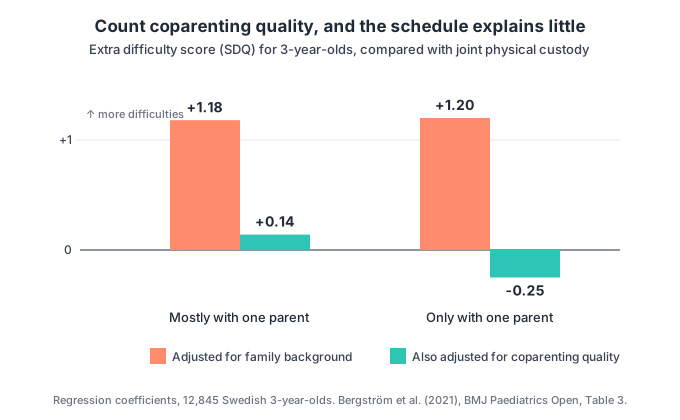
A Swedish population study of 12,845 three-year-olds compared children in joint physical custody, children living mostly with one parent, and children living only with one parent. Before adjusting for anything else, the sole-care arrangements were associated with more mental health problems while joint physical custody did not differ significantly from intact families. Then the researchers adjusted the analysis for coparenting quality, measured on a four-item scale. After that adjustment, the differences between the post-divorce living arrangements were minimal.[12]
The arrangement was largely standing in for the relationship. Once you account for how well the two adults actually coparent, which schedule the children were on stopped explaining much.
The same study found something else worth sitting with. Low coparenting quality was more strongly related to mental health problems for children in intact families and in joint physical custody than for children living mostly or only with one parent.[12] More shared time means more contact between the adults, which is protective when the coparenting is decent and costly when it is not.
That is not a new observation. The 1991 adolescent study found exactly the conditional pattern: adolescents in dual residence were especially likely to feel caught when their parents were in high conflict, and especially unlikely to feel caught when their parents cooperated.[8] Shared residence is not good or bad. It is an amplifier.
The time question has a further wrinkle. A study of 141 children aged 9 to 18 from families in a court-based programme for high-conflict divorce examined parenting time, parenting quality and conflict together. Fathers' parenting quality mediated the association between parenting time and children's internalising problems, both at the time and nine months later. And there was a significant curve: more parenting time went with a better father-child relationship up to a point, beyond which more time was not related to a better relationship.[14] This was a modest sample from a high-conflict population, so do not over-read it. But the direction is a useful corrective to the assumption that the answer is always more hours.
Two large Swedish studies point the same way on wellbeing. Children who shared their time between both parents' homes did not differ in self-esteem from peers in nuclear families, while children in single care reported lower self-esteem, and the difference was not explained by socioeconomic factors.[13] All of this is observational. Parents who manage equal shared care are different from parents who do not, in ways no statistical adjustment fully removes, and the authors of these studies say so. Nobody has randomly assigned children to custody arrangements and nobody is going to.
The interview study behind those cohorts is quietly the most human document in this whole literature. Researchers talked to 46 separated parents raising 1 to 4 year olds in equal shared care. Good communication was the thing that made it work, and it lessened the sense of being cut off from half of the child's life. Where the arrangement was court-ordered or the conflict was intense, parents tried to have less contact with each other and worried when the children were in the other home. Most were pleased with the arrangement, **with the notable exception of couples experiencing ongoing conflict**.[21]
The Two Pathways That Have Nothing To Do With Conflict
Conflict is the headline. It is not the whole list. The major review of this field names four mediators between divorce and children's adjustment: income, interparental conflict, parenting, and parents' own wellbeing.[16]
Money. This one gets skipped in parenting content because there is nothing uplifting to say about it. The American Academy of Pediatrics clinical report on divorce and separation is blunt: after divorce the disparity in resources tends to increase the inequality of money available for children and results in a significant increase in child poverty, and it cites census figures showing **28% of children in divorced families living below the poverty threshold compared with 15.9% of the total population**.[15] The original meta-analysis found economic disadvantage was one of the two perspectives with some support behind it.[1]
If your household income fell, that is not a side issue you should feel embarrassed about noticing. It is one of the four recognised pathways. Practical help with money is child mental health work, and it is rarely framed that way.
Your own wellbeing. The AAP report describes what happens to parents, not just children: mothers more likely to feel stressed and humiliated and to seek mental health services, fathers often feeling alienated, less accepting of their children, and vulnerable to depression, anxiety and substance use.[15] Parents' wellbeing is on the mediator list for a reason.[16]
And there is trial evidence rather than just correlation. When researchers evaluated a parenting programme for divorced and separated families against families who attended nothing, the programme strengthened parenting quality and also **reduced child exposure to interparental conflict and parent psychological distress**, alongside reducing children's internalising problems.[22]
Your state is inside the mechanism. Not as a nice-to-have. As a measured pathway.
When the Standard Advice Doesn't Fit
The research above describes averages across large groups. Several groups of families sit outside those averages, and they are the ones most often handed advice that cannot work.
Kids whose temperament makes them more reactive to the thing you are already worried about. A study of 231 mothers and children aged 9 to 12 who had been through divorce in the previous two years looked at parenting and temperament together. Parental rejection was more strongly related to adjustment problems for children low in positive emotionality. Inconsistent discipline was more strongly related to adjustment problems for children high in impulsivity.[17]
Read that second one again if you are running two households with different rules. Inconsistency is not equally costly for every child. For an impulsive kid it is more costly. That is not a reason to despair about the other house. It is a reason to be relentlessly predictable in yours, where predictability is the only variable you control.
Neurodivergent kids. The divorce literature has very little to say about them specifically, and I am not going to pretend otherwise. What the surrounding literature says is that the standard advice generally fits worse, and the reasons are mechanical rather than mysterious. Differences in emotional regulation, sensory processing, executive function and transition tolerance all interact with an arrangement built around transitions. I have written about how much standard guidance simply did not fit on sleep and about how anxiety gets read as defiance, and both of those mechanisms run straight through exchange days. Extrapolating from adjacent research is not the same as evidence about this population, and I am flagging it as extrapolation.
Families where the other household will not cooperate. Everything in the coparenting-quality section is easy to read as a verdict on you if the other adult is not participating. It is not. The mechanism that carries most of the damage is the child's position inside the conflict, and that position is something you influence unilaterally.[8] You do not need agreement to stop passing messages through a child.
Families where the issue is not conflict but safety. Nothing above applies to a household where someone is being hurt. The AAP report notes that divorce in a family with a history of child abuse is related to a greater incidence of conduct disorder, post-traumatic stress disorder and suicide attempts in children than either divorce or child abuse alone.[15] "Reduce conflict" is not the frame for that situation, and separation in that context may be the protective act rather than the harmful one. The crisis resources further down are the relevant section, not this one.
Families the programmes were not designed around. The largest trial of the best-supported programme in this field found benefits that were moderated, with positive effects for non-Hispanic White families but not for Hispanic families, and the authors named the need for further adaptation.[20] That is a limitation worth stating loudly rather than burying. The evidence base here is disproportionately white, English-speaking and North American or Northern European. If your family is not, the honest answer is that less of this was tested on people like you.
My Own Reckoning
In a post about conflict and children, the version of this you usually get is a parent admitting they put a kid in the middle of it. That is not mine. I am careful about it to the point of stiffness: I do not ask my daughters about the other house, I do not react in front of them to whatever comes back, and I do not let them carry anything between two adults.
So what I am owning up to here is quieter than that, and unflattering in a different direction.
I am afraid of being late to exchanges. Not mildly, either. I build the whole last hour of our time together around not being late, and what that fear actually does is push my daughters out the door before I have checked on them. I do not ask whether anyone needs the bathroom, I do not slow down for a proper goodbye with family who came to see them, I just move them, because the clock is the thing I am watching.
We have pulled over for a potty break ten minutes down the road more than once, which tells you it was never really about those ten minutes, and we have left goodbyes half-finished. Those are small losses, and no chart anywhere records them, but they are losses all the same, and they belong to me rather than to the arrangement.
The reason I am like that is the part that belongs next to the research above. Being late is not just being late. I believe it would be counted, and kept, and used later, so a clock that has nothing to do with my daughters ends up deciding how the last ten minutes with them go.
That is what the evidence in this post kept describing from the other direction. The conflict does not have to reach a child directly in order to reach them, because it can travel through the parent who is being careful, and I could not see it happening from the inside, where it only ever felt like being responsible.
What To Do Instead
Each of these is tied to a mechanism above, so you can tell which ones matter for your situation and drop the rest. None of them requires the other household's agreement.
1. Treat "is my child inside this" as the question, not "how much do we fight." Conflict reached children in the research through their felt position between the parents.[8] Before any interaction with the other adult, ask where your child will be standing when it happens. That is the variable with the evidence behind it.
2. Stop using your child as a channel. No messages passed, no schedule negotiated through them, no information gathered from them about the other house. Role diffusion showed up as a specific risk factor in a meta-analysis of nearly 25,000 divorced families.[10] Every question you ask them about the other household is a small request to take a side, even when it is not meant that way.
3. Control your face, not just your words. Conflict in this literature is explicitly not limited to shouting. It can be covert.[7] Children read a silence, a jaw, a change in tone on the phone. A child who has to decode your reaction is doing the same work as a child listening to an argument.
4. Be boringly predictable in your own house. Inconsistent discipline was more strongly linked to problems for impulsive children specifically.[17] You cannot standardise across two homes. You can make one of them completely legible. Same bedtime, same expectations, same response to the same behaviour.
5. Put the relationship work first anyway, and know what it does and does not do. Improving the parent-child relationship produced measurable gains in children's coping years later in a randomised trial.[19] It also did not shield children from conflict exposure in a recent study.[11] Do it because it works on its own terms, not because it buys you cover elsewhere.
6. Say the sentence out loud, more than once. The clinical guidance is explicit that the child needs to be reassured that they did not cause the separation and cannot solve it.[15] Children under about eight often blame themselves, and that self-blame does not appear as a confession. It appears as behaviour.
7. Stop optimising the calendar past the point where it helps. More parenting time tracked with a better father-child relationship only up to a point in one study of high-conflict families, and coparenting quality washed out most of the differences between arrangements in another.[14][12] Time spent improving how the handoff goes may be worth more than time spent litigating how many nights it precedes.
8. Treat money and your own mental health as part of the child's treatment plan. Both are named mediators.[16] A programme that reduced parents' psychological distress also reduced children's internalising problems.[22]
9. Consider a structured programme rather than more reading. The strongest evidence in this entire field is not for any insight. It is for attending a structured parenting programme, which is the next section.
The Recovery Evidence
If the sections above described harm, this one is the correction, and it is the part of the literature I would most want a frightened parent to read.
First, the clinical baseline. The American Academy of Pediatrics clinical report states that although many children show behaviour changes in the first year after a separation, **most adjustment problems resolve in two to three years**, while noting the child's sense of loss may last longer and flare at holidays and birthdays.[15] The first year is not the forecast.
Second, and more important: this has been tested experimentally, which almost nothing in parenting has.
Researchers randomised divorced families to a parenting programme for mothers, the same programme plus a children's group, or a control condition that received books on post-divorce adjustment. Then they went back six years later and re-interviewed 218 families, 91% of the original sample, when the children were adolescents aged 15 to 19.
Among adolescents whose families had received the mother-plus-child programme, 11% had a one-year prevalence of a diagnosed mental disorder. In the control group the figure was 23.5%. The programme groups also showed lower externalising problems, fewer symptoms of mental disorder, and less alcohol, marijuana and other drug use, with the largest benefits for the children who had started out with the highest problem levels.[18]
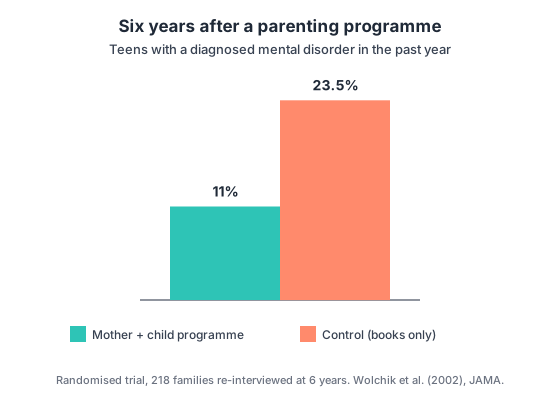
Sit with what that design proves. These were not the families who were doing best. They were randomly assigned. The difference six years later came from a programme of group sessions delivered after the separation had already happened.
A separate analysis of the same body of work traced the pathway. Improvements in mother-child relationship quality produced by the intervention led to increases in children's coping efficacy at six months and increases in coping efficacy and active coping six years later.[19]
The trajectory after a separation is not set at the separation. It responds to what happens next, and it responds measurably, years out, to changes an ordinary parent can make.
That is the most hopeful sentence in this post, and unlike most hopeful sentences in parenting content, it comes from a randomised trial published in JAMA.
The honest caveats belong here too. The largest effectiveness trial, with 830 parents recruited through family courts in four counties, found the programme worked when delivered by community agencies, but the benefits were moderated and did not appear for Hispanic families in that sample.[20] Effects are real. They are not universal, and the field knows it.
When To Get Help
Some of what follows is normal and resolves. Some of it warrants a professional. The clinical report describes what reactions look like at different ages, which is useful because the same distress presents completely differently depending on how old the child is.[15]
In infants and toddlers, reactions to disrupted routine and caregiving: increased fussiness or listlessness, sleep and feeding disturbance, heightened separation anxiety, and developmental regression including loss of toileting or language skills.
In preschoolers, repeatedly asking for the absent parent, demanding or defiant behaviour, sleep and eating problems, nightmares, and by about four or five, self-blame and fear of being abandoned.
In school-aged children, self-blame, fantasies about the parents reuniting, withdrawal and anger, declining school performance, and feeling abandoned by the parent no longer in the home.
In adolescents, taking on adult roles, de-idealising one or both parents, aggressive or delinquent behaviour, withdrawal, substance use, and poor school performance.[15]
Get professional help when:
- Any of the above is severe, or is not improving over months rather than weeks. The clinical
window is telling you something.[15]
- Your child is being used as a messenger, an informant or a confidant and you cannot stop it. This
- A child of any age expresses that they caused the separation and reassurance is not landing.
- Substance use, self-harm, or any talk of not wanting to be here.
- Your own depression, anxiety or substance use is the thing that has changed most. Your wellbeing is
- You want to do something with actual evidence behind it. Court-affiliated and community parenting
area.[18][20] Ask your family court, a family therapist, or your child's pediatrician what is available locally. The AAP directs pediatricians to refer families to mental health and child-oriented resources with expertise in divorce.[15]
If there is any danger, these are the numbers. They were verified current at the time of writing.
- 988 Suicide & Crisis Lifeline: call or text 988. Free, confidential, 24/7. Text and chat
callers. 988lifeline.org
- Childhelp National Child Abuse Hotline: call 1-800-422-4453, or text GO to the same
- National Domestic Violence Hotline: call 1-800-799-SAFE (7233), or text START to
855-812-1001. thehotline.org
If a household is unsafe, none of the balancing and de-escalation advice in this post applies. Safety comes first and separation may be the protective act.
If You're Reading This
If you have just separated and you are terrified you have already ruined them: the evidence says the legal event is close to the least important variable, that a meaningful share of what gets blamed on divorce was measurable before it happened, and that the single largest factor is something that remains open to change for years afterward.[4][7][18] You are at the beginning of the part that matters, not the end of it.
If you are years past it and you are reading this as an audit of what you did wrong: the recovery evidence is not a consolation prize. A randomised trial found a difference in diagnosed disorders six years out, and the largest benefits went to the children who had been struggling most.[18] Later is still inside the window.
If the other household will not cooperate: most of the mechanism runs through whether your child is standing inside the conflict, and that is not a joint decision.[8] You can do the single most evidenced thing on this list alone, starting tonight, without anyone agreeing to anything.
If you are still in the marriage and reading this to decide: this post cannot make that decision and will not pretend to. What the research does say is that conflict between parents affects children whether the adults are living together or not.[9] Staying is not automatically the protective choice, and leaving is not automatically the damaging one. The variable that follows your children into either future is the conflict and their position in it.
If you are a co-parent of a neurodivergent child: you are working with the thinnest evidence base in this post. What is known about transitions, executive function and demand tolerance suggests the exchange itself deserves more of your attention than the split does.
If the thing you actually cannot fix is money: you did not fail at a parenting task. You are inside one of the four recognised pathways, and it is the one the parenting industry has the least to say about because there is nothing to sell you.[15][16]
The Bottom Line
The divorce is not the thing that predicts how your children do. The things that predict it are whether they end up standing inside the conflict between you, how consistent and warm the parenting is in the homes they are in, what happened to the household's money, and how the adults raising them are doing.[16][7]
The average difference between children of divorced and married parents is real and small, and it says almost nothing about any particular child.[1][2]
Most of what matters is not fixed, and one of the most important pieces is available to a parent acting alone. You cannot make the other adult cooperate. You can refuse, every single time, to let your child be the room the argument happens in.
And if the last year has been bad, that is not the forecast. The strongest evidence in this field says a family's trajectory was still changing six years later.[18]
Resources & Further Reading
Programmes with actual trial evidence. The New Beginnings Program is the most rigorously tested intervention for separated and divorced families, with two efficacy trials, a long-term follow-up published in JAMA and a large community effectiveness trial.[18][20] Ask your family court's self-help centre or family services office what court-affiliated parenting programmes they run. Many are free or low cost and some are already required in a divorce filing.
The one clinical document worth reading in full. The American Academy of Pediatrics clinical report Helping Children and Families Deal With Divorce and Separation (2016, reaffirmed 2022) is free to read and is the most compact source for age-by-age reactions and referral thresholds.[15] Read it here.
If you want to read the research yourself. The 2022 DPCATT review is open access and is the single best synthesis of how pre- and post-divorce conflict shapes children's trajectories, including the distinctions between overt and covert conflict most articles ignore.[7] Read it here.
On our site. If the conflict in your situation shows up as raised voices, the research on what that does and how repair works is in The Invisible Echo. If your child's distress is coming out as defiance, that mechanism is here. If bedtime is where the strain lands, start here. If the two houses run different rules at the dinner table, this is about exactly that.
A request, if you have got this far. The practical version of all of this is finding activities a child can actually attend on an every-other-week schedule, which is the reason this site exists. We are building a list of programmes that separated parents say are workable with a custody schedule. It is new and still short. If you have found one that works, or one that would not bend, add a report here. It takes two minutes and it is the only way that list gets built.
References
↑ [1]: Amato, P. R., & Keith, B. (1991). "Parental divorce and the well-being of children: a meta-analysis." Psychological Bulletin, 110(1), 26–46. PMID: 1832495. Available at: https://doi.org/10.1037/0033-2909.110.1.26
↑ [2]: Amato, P. R. (2001). "Children of divorce in the 1990s: an update of the Amato and Keith (1991) meta-analysis." Journal of Family Psychology, 15(3), 355–370. PMID: 11584788. Available at: https://doi.org/10.1037/0893-3200.15.3.355
↑ [3]: Hjern, A., Urhoj, S. K., Fransson, E., & Bergström, M. (2021). "Mental Health in Schoolchildren in Joint Physical Custody: A Longitudinal Study." Children, 8(6), 473. PMID: 34199778. Available at: https://doi.org/10.3390/children8060473
↑ [4]: Cherlin, A. J., Furstenberg, F. F., Chase-Lansdale, L., Kiernan, K. E., Robins, P. K., Morrison, D. R., & Teitler, J. O. (1991). "Longitudinal studies of effects of divorce on children in Great Britain and the United States." Science, 252(5011), 1386–1389. PMID: 2047851. Available at: https://doi.org/10.1126/science.2047851
↑ [5]: D'Onofrio, B. M., Turkheimer, E., Emery, R. E., Slutske, W. S., Heath, A. C., Madden, P. A., & Martin, N. G. (2005). "A genetically informed study of marital instability and its association with offspring psychopathology." Journal of Abnormal Psychology, 114(4), 570–586. PMID: 16351381. Available at: https://doi.org/10.1037/0021-843X.114.4.570
↑ [6]: D'Onofrio, B. M., Turkheimer, E., Emery, R. E., Maes, H. H., Silberg, J., & Eaves, L. J. (2007). "A Children of Twins Study of parental divorce and offspring psychopathology." Journal of Child Psychology and Psychiatry, 48(7), 667–675. PMID: 17593147. Available at: https://doi.org/10.1111/j.1469-7610.2007.01741.x
↑ [7]: Cao, H., Fine, M. A., & Zhou, N. (2022). "The Divorce Process and Child Adaptation Trajectory Typology (DPCATT) Model: The Shaping Role of Predivorce and Postdivorce Interparental Conflict." Clinical Child and Family Psychology Review, 25(3), 500–528. PMID: 35106699. Available at: https://doi.org/10.1007/s10567-022-00379-3
↑ [8]: Buchanan, C. M., Maccoby, E. E., & Dornbusch, S. M. (1991). "Caught between parents: adolescents' experience in divorced homes." Child Development, 62(5), 1008–1029. PMID: 1756653. Available at: https://doi.org/10.1111/j.1467-8624.1991.tb01586.x
↑ [9]: Harold, G. T., & Sellers, R. (2018). "Annual Research Review: Interparental conflict and youth psychopathology: an evidence review and practice focused update." Journal of Child Psychology and Psychiatry, 59(4), 374–402. PMID: 29574737. Available at: https://doi.org/10.1111/jcpp.12893
↑ [10]: van Dijk, R., van der Valk, I. E., Deković, M., & Branje, S. (2020). "A meta-analysis on interparental conflict, parenting, and child adjustment in divorced families: Examining mediation using meta-analytic structural equation models." Clinical Psychology Review, 79, 101861. PMID: 32512420. Available at: https://doi.org/10.1016/j.cpr.2020.101861
↑ [11]: O'Hara, K. L., Cummings, E. M., & Davies, P. T. (2024). "Interparental conflict and adolescent emotional security across family structures." Family Process, 63(1), 265–283. PMID: 36929144. Available at: https://doi.org/10.1111/famp.12872
↑ [12]: Bergström, M., Salari, R., Hjern, A., Hognäs, R., Bergqvist, K., & Fransson, E. (2021). "Importance of living arrangements and coparenting quality for young children's mental health after parental divorce: a cross-sectional parental survey." BMJ Paediatrics Open, 5(1), e000657. PMID: 34124394. Available at: https://doi.org/10.1136/bmjpo-2020-000657
↑ [13]: Turunen, J., Fransson, E., & Bergström, M. (2017). "Self-esteem in children in joint physical custody and other living arrangements." Public Health, 149, 106–112. PMID: 28595062. Available at: https://doi.org/10.1016/j.puhe.2017.04.009
↑ [14]: O'Hara, K. L., Sandler, I. N., Wolchik, S. A., Tein, J. Y., & Rhodes, C. A. (2019). "Parenting time, parenting quality, interparental conflict, and mental health problems of children in high-conflict divorce." Journal of Family Psychology, 33(6), 690–703. PMID: 31318261. Available at: https://doi.org/10.1037/fam0000556
↑ [15]: Cohen, G. J., Weitzman, C. C., Committee on Psychosocial Aspects of Child and Family Health, & Section on Developmental and Behavioral Pediatrics. (2016). "Helping Children and Families Deal With Divorce and Separation." Pediatrics, 138(6), e20163020. Reaffirmed June 2022. PMID: 27940730. Available at: https://doi.org/10.1542/peds.2016-3020
↑ [16]: Lansford, J. E. (2009). "Parental Divorce and Children's Adjustment." Perspectives on Psychological Science, 4(2), 140–152. Available at: https://doi.org/10.1111/j.1745-6924.2009.01114.x
↑ [17]: Lengua, L. J., Wolchik, S. A., Sandler, I. N., & West, S. G. (2000). "The additive and interactive effects of parenting and temperament in predicting adjustment problems of children of divorce." Journal of Clinical Child Psychology, 29(2), 232–244. PMID: 10802832. Available at: https://doi.org/10.1207/S15374424jccp2902_9
↑ [18]: Wolchik, S. A., Sandler, I. N., Millsap, R. E., Plummer, B. A., Greene, S. M., Anderson, E. R., Dawson-McClure, S. R., Hipke, K., & Haine, R. A. (2002). "Six-year follow-up of preventive interventions for children of divorce: a randomized controlled trial." JAMA, 288(15), 1874–1881. PMID: 12377086. Available at: https://doi.org/10.1001/jama.288.15.1874
↑ [19]: Vélez, C. E., Wolchik, S. A., Tein, J. Y., & Sandler, I. (2011). "Protecting children from the consequences of divorce: a longitudinal study of the effects of parenting on children's coping processes." Child Development, 82(1), 244–257. PMID: 21291440. Available at: https://doi.org/10.1111/j.1467-8624.2010.01553.x
↑ [20]: Sandler, I., Wolchik, S., Mazza, G., Gunn, H., Tein, J. Y., Berkel, C., Jones, S., & Porter, M. (2020). "Randomized Effectiveness Trial of the New Beginnings Program for Divorced Families with Children and Adolescents." Journal of Clinical Child & Adolescent Psychology, 49(1), 60–78. PMID: 30644774. Available at: https://doi.org/10.1080/15374416.2018.1540008
↑ [21]: Bergström, M., Sarkadi, A., Hjern, A., & Fransson, E. (2019). "'We also communicate through a book in the diaper bag': Separated parents' ways to coparent and promote adaptation of their 1-4 year olds in equal joint physical custody." PLoS ONE, 14(4), e0214913. PMID: 30970037. Available at: https://doi.org/10.1371/journal.pone.0214913
↑ [22]: Tein, J. Y., Mazza, G. L., Gunn, H. J., Kim, H., Stuart, E. A., Sandler, I. N., & Wolchik, S. A. (2018). "Multigroup Propensity Score Approach to Evaluating an Effectiveness Trial of the New Beginnings Program." Evaluation & the Health Professions, 41(2), 290–320. PMID: 29635949. Available at: https://doi.org/10.1177/0163278718763499
Tags
Written by
Steadykeep
Published
September 23, 2026